
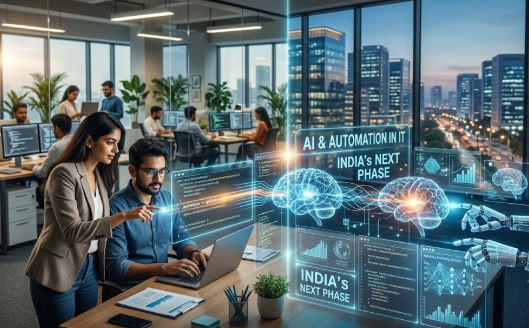
India’s IT services industry is entering a defining phase as artificial intelligence (AI) and automation transform the way software is developed, delivered and maintained. For decades, the sector built its global reputation on a large skilled workforce, cost-effective outsourcing and the ability to deliver technology services at scale. However, the rapid adoption of generative AI, intelligent coding assistants and automated software testing is challenging this traditional business model and creating new opportunities for growth.
AI-powered software development is enabling companies to write code faster, identify errors, automate repetitive tasks and manage complex development processes with fewer manual interventions. This is changing not only project delivery but also the economics of the IT services business. As clients increasingly demand faster outcomes, greater efficiency and measurable returns on technology investments, Indian IT companies are being pushed to move beyond conventional manpower-based outsourcing towards specialised, innovation-led services.
How AI Is Transforming India’s IT Services Industry
1. Automation Is Changing Traditional Software Development
Software development, which once required extensive manual coding, testing and debugging, is becoming increasingly automated. Generative AI tools can assist developers in writing code, identifying technical errors, preparing documentation and improving existing applications.
These capabilities are reducing the time required to complete routine development tasks and allowing technology teams to concentrate on more complex assignments. For IT service providers, this creates opportunities to improve project delivery, manage costs and handle larger workloads without proportionately increasing their workforce.
2. Entry-Level IT Jobs Are Facing a Changing Landscape
One of the most significant consequences of AI adoption is its impact on entry-level technology roles. Tasks such as basic programming, software testing, documentation and technical support are increasingly being supported by automated systems.
This is prompting IT companies to reconsider traditional recruitment strategies, particularly for positions involving repetitive work. Although AI is unlikely to eliminate the need for fresh talent, employers are placing greater emphasis on practical technical knowledge, problem-solving abilities and familiarity with AI-assisted development tools.
For young professionals and graduates, the message is increasingly clear: understanding programming languages alone may no longer be sufficient. The ability to work alongside AI systems and apply technology to real business challenges will become an important career advantage.
3. The Traditional IT Services Business Model Is Under Pressure
India’s IT industry has historically depended on a workforce-driven revenue model, in which companies expanded their employee base to accommodate growing client requirements. Revenue was closely linked to the number of professionals deployed and the hours billed for project execution.
AI is beginning to challenge this relationship. Automation allows developers to complete certain assignments more quickly, potentially reducing the number of billable hours required for a project. While this can improve productivity and client satisfaction, it also places pressure on traditional pricing structures.
Consequently, IT companies are exploring outcome-based contracts, fixed-price engagements and specialised consulting arrangements. Instead of charging primarily for the number of professionals deployed, service providers are increasingly expected to demonstrate the business value created through their technology solutions.
4. Growing Opportunities in AI Engineering and Specialised Services
While automation is changing conventional technology roles, it is also creating demand for specialised skills. Businesses need professionals who can develop, deploy and maintain AI-powered applications while ensuring that these systems remain secure, reliable and aligned with organisational requirements.
Areas such as machine learning, data engineering, cloud computing, AI governance, cybersecurity and large language model operations are gaining importance.
Indian IT companies have an opportunity to strengthen their position in these emerging segments by investing in workforce training and building specialised technology capabilities. This shift could help service providers move towards higher-value projects and develop deeper relationships with international clients.
5. Small Businesses and Startups Could Benefit from AI-Powered Development
AI-driven software development is also creating opportunities beyond large technology companies. Startups and small businesses can increasingly use AI-assisted development tools to build applications, automate internal processes and improve digital services without maintaining large engineering teams.
Lower development costs and shorter project timelines could make customised software more accessible to smaller organisations. Businesses can use these solutions to streamline inventory management, customer service, accounting, sales operations and data analysis.
For India’s startup ecosystem, this could encourage faster product development and allow emerging companies to test business ideas with comparatively lower initial technology investments. At the same time, demand for specialised developers and technology consultants is likely to grow as businesses seek customised and secure AI solutions.
6. Competition Among Indian IT Companies Is Intensifying
The adoption of AI is becoming an important competitive factor for India’s major IT service providers. Companies that successfully integrate automation into their delivery models could improve operational efficiency, reduce project turnaround times and offer more competitive pricing.
However, adopting AI tools alone will not guarantee business success. Service providers must also address data security, intellectual property protection, regulatory compliance and the reliability of AI-generated outputs.
The ability to combine human expertise with intelligent automation will therefore become a major differentiator. Companies that can deliver dependable, industry-specific solutions are likely to be better positioned to capture emerging technology spending.
Conclusion
The rise of AI-powered software development represents more than a technological upgrade for India’s IT services industry; it signals a fundamental shift in how technology businesses create value and compete globally. As automation takes over repetitive development activities, the industry’s traditional dependence on workforce expansion and billable hours is likely to face increasing pressure.
However, this transition also presents a significant growth opportunity. Greater demand for AI engineering, cloud integration, cybersecurity, intelligent automation and specialised software solutions could open new revenue streams for Indian technology companies. The challenge will be to prepare the workforce, redesign service delivery models and invest in capabilities that go beyond routine outsourcing.
India’s long-standing strength in software development and technology talent provides a strong foundation for this transformation. The companies that successfully combine human expertise, AI capabilities and business-focused innovation will be better placed to lead the next phase of the country’s IT services growth.