
In this story
New Delhi, Nov 11: India’s pharmaceutical manufacturing industry continues to play a crucial role in supplying medicines to the United States, highlighting the challenges facing President Donald Trump’s efforts to bring generic drug production back to American soil, according to a report.
Representational Image
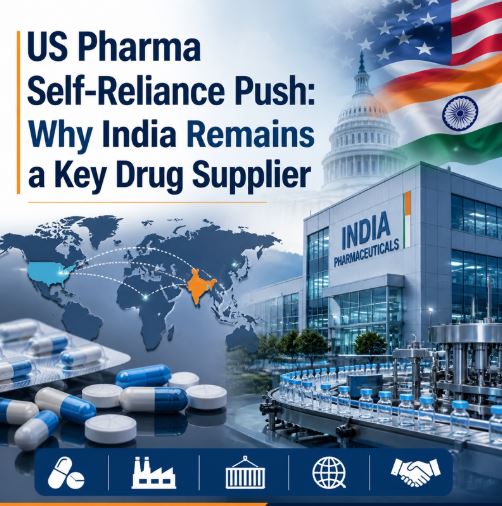
A report by The Star has highlighted the scale of India’s pharmaceutical manufacturing capabilities, citing a major production facility operated by a leading drugmaker in Hyderabad. The facility employs nearly 1,900 workers and manufactures more than 100 generic medicines, including drugs used to treat high cholesterol, allergies and depression.
The plant produces close to one billion oral doses every month, with approximately 75 per cent of its output shipped to the US market, the report said.
India’s extensive generic drug manufacturing network has made it an important contributor to global pharmaceutical supply chains, particularly in the United States.
Generic medicines account for nearly 90 per cent of prescriptions dispensed in the US, while Indian pharmaceutical companies supply around 40 per cent of these medicines.
Trump’s Tariff Push Poses Challenges for US Drug Industry
President Donald Trump has proposed imposing steep tariffs on imported generic medicines as part of his broader strategy to encourage domestic pharmaceutical manufacturing.
The proposals include a 100 per cent tariff on certain imported generic drugs from 2028, rising to 200 per cent a year later.
However, industry executives and healthcare experts believe that shifting large-scale generic drug production to the US could prove difficult because of the cost advantages and manufacturing expertise developed by Indian pharmaceutical companies over several decades.
According to industry estimates cited in the report, manufacturing most generic medicines in the US could cost up to four times more than producing them in India.
Lower labour costs, faster factory construction, established manufacturing infrastructure and a skilled workforce continue to provide Indian drugmakers with a significant competitive advantage.
How India Became a Global Generic Drug Manufacturing Hub
India’s pharmaceutical industry’s growth can be traced back to the 1970s, when the country focused on making medicines more affordable and accessible.
Over the years, Indian companies developed strong capabilities in pharmaceutical manufacturing, reverse engineering and large-scale production of generic medicines.
This helped the country emerge as a major supplier of affordable drugs to international markets, including the US.
Although concerns over manufacturing quality had affected the industry’s reputation in the past, regulatory oversight and compliance standards have strengthened considerably.
Leading Indian pharmaceutical manufacturers now face regular inspections by international regulatory agencies and have made substantial investments in quality control, manufacturing standards and compliance systems.
India-US Cooperation Seen as Key to Drug Supply Security
Industry leaders believe that deeper cooperation between India and the United States could offer a more practical solution than attempting to separate the two pharmaceutical industries.
Both countries are seeking to reduce their dependence on China for pharmaceutical ingredients and strengthen the resilience of their medicine supply chains.
In this context, India’s established manufacturing infrastructure, technical expertise and cost competitiveness could make it an important partner for the US pharmaceutical sector.
The growing dependence of American healthcare on Indian generic medicines also underlines the complexities of rebuilding domestic manufacturing capacity while ensuring affordable and uninterrupted access to essential drugs.
As Washington pushes for greater pharmaceutical self-reliance, India’s role in the global generic medicine market is likely to remain strategically significant.