

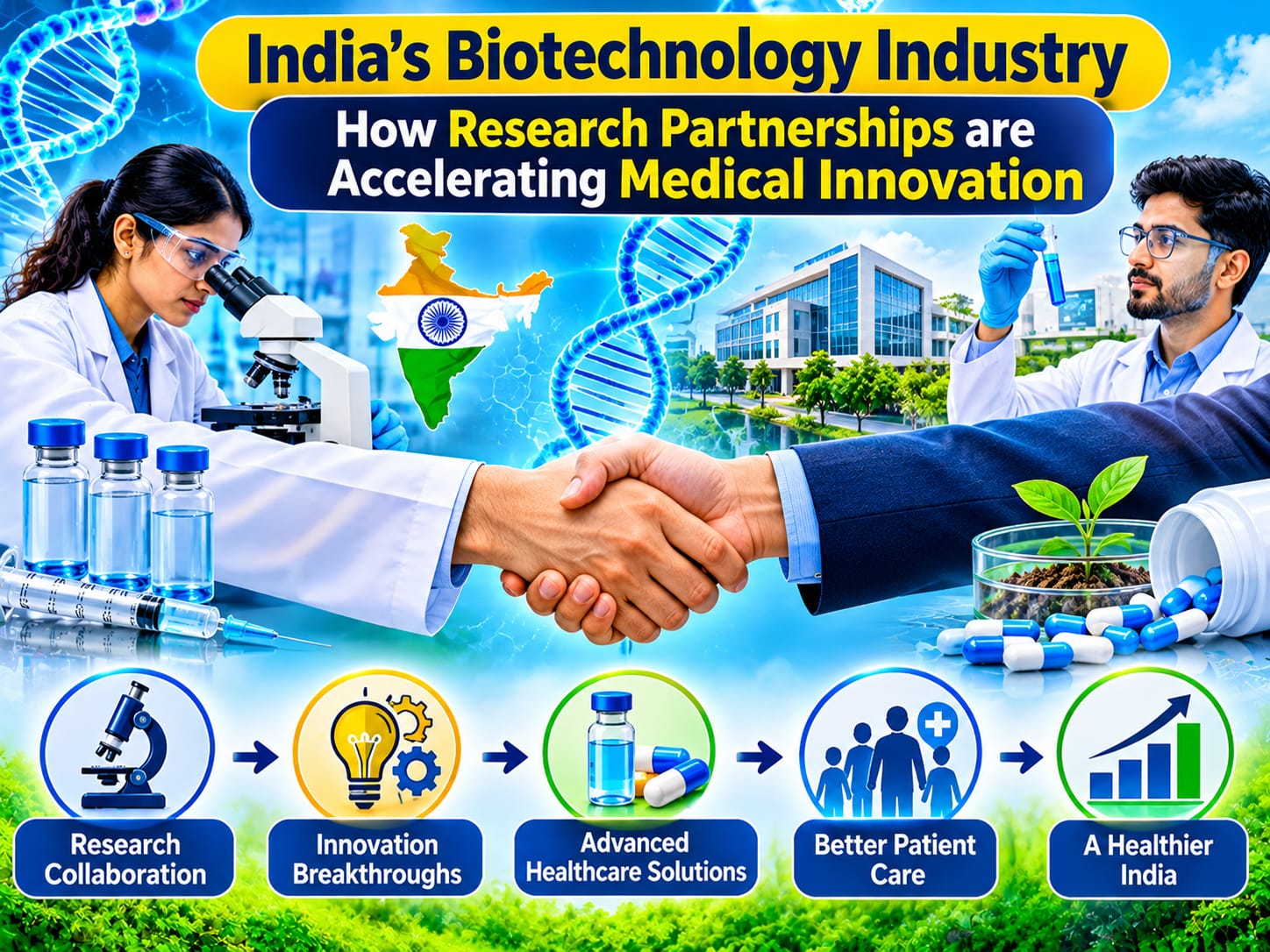
Nov 11: India’s biotechnology industry is entering a new phase of growth, driven by scientific research, technological advancements, and increasing collaboration between pharmaceutical companies, academic institutions, research laboratories, startups, and international organisations. Traditionally recognised for its affordable generic medicines and vaccine manufacturing capabilities, India is gradually strengthening its position in advanced biomedical research, biologics, biosimilars, genomics, precision medicine, and innovative medical technologies. Research partnerships are playing an important role in this transformation by connecting scientific discoveries with practical healthcare applications, encouraging investment in research and development (R&D), and helping bring new medical solutions to patients. With government-backed initiatives, expanding biotechnology infrastructure, and growing international cooperation, India is building an innovation ecosystem that could strengthen its contribution to global healthcare while improving access to affordable and advanced medical treatments.
India’s Biotechnology Industry: Growth, Economic Contribution and Emerging Opportunities
India’s biotechnology sector has become an important contributor to the country’s economic development, healthcare infrastructure, and scientific capabilities. The expansion of biotechnology startups, pharmaceutical research facilities, vaccine manufacturers, and life sciences companies is creating new opportunities across healthcare, agriculture, industrial biotechnology, and environmental sustainability.
According to the India Bioeconomy Report 2026, published by the Association of Biotechnology Led Enterprises (ABLE), India’s bioeconomy reached approximately $195.3 billion in 2025, representing annual growth of 18%. The sector’s increasing contribution to the national economy reflects the growing importance of biotechnology in industrial development, healthcare innovation, and employment generation.
India also has an established position in global vaccine manufacturing, supplying a significant proportion of the world’s vaccine requirements. Its pharmaceutical manufacturing capabilities, skilled scientific workforce, expanding research infrastructure, and cost-efficient production ecosystem provide a strong foundation for developing more advanced medical technologies.
Some of the major areas creating opportunities for the biotechnology industry include:
- Biopharmaceuticals: Development of biologics, biosimilars, vaccines, therapeutic proteins, and advanced medicines for complex diseases.
- Genomics and precision medicine: Using genetic information to understand disease risks and develop treatments suited to individual patients.
- Medical biotechnology: Developing innovative diagnostic tools, medical devices, cell therapies, and gene-based treatments.
- Agricultural biotechnology: Applying scientific research to improve crop productivity, plant resistance, and sustainable agricultural practices.
- Industrial biotechnology: Using biological processes and microorganisms to develop sustainable materials, biofuels, and industrial products.
- Digital biotechnology: Integrating artificial intelligence, machine learning, bioinformatics, and advanced computing into drug discovery and biomedical research.
As these segments expand, collaboration between research institutions and commercial organisations is becoming increasingly important for translating scientific knowledge into practical products and services.
Why Research Partnerships Are Becoming Important for Medical Innovation
Medical innovation involves several stages, beginning with scientific discovery and laboratory research and extending to clinical trials, regulatory approval, manufacturing, and commercial distribution. Each stage requires specialised knowledge, advanced infrastructure, financial resources, and regulatory expertise.
Universities and research institutions often possess strong scientific capabilities, but they may not have the manufacturing infrastructure or commercial experience required to develop products on a large scale. Similarly, pharmaceutical companies and biotechnology startups may have the resources to manufacture and distribute medical products but require access to specialised research, clinical expertise, and advanced scientific technologies.
Research partnerships help bridge this gap by bringing different stakeholders together.
Through industry-academia collaborations, pharmaceutical companies can work with universities and medical institutions to identify promising research opportunities, validate new treatment methods, and accelerate product development. Government-supported research programmes can provide funding and infrastructure, while international partnerships introduce advanced technologies, scientific expertise, and access to global research networks.
These collaborations can improve the overall innovation process by:
- Sharing research infrastructure, specialised equipment, and scientific expertise.
- Reducing the financial burden associated with early-stage research and product development.
- Supporting clinical validation and regulatory preparedness.
- Encouraging the commercialisation of laboratory discoveries.
- Improving access to international research networks and technology.
- Strengthening the development of affordable medicines and diagnostic solutions.
As a result, research partnerships are becoming an essential part of India’s strategy to move beyond traditional pharmaceutical manufacturing towards innovation-led biotechnology development.
Government Initiatives Strengthening India’s Biotechnology Research Ecosystem
Government support is an important factor in expanding India’s biotechnology research capabilities. Several national programmes are designed to encourage scientific innovation, improve access to research infrastructure, support emerging biotechnology companies, and strengthen cooperation between academic institutions and industry.
Biotechnology Industry Research Assistance Council (BIRAC)
The Biotechnology Industry Research Assistance Council (BIRAC) operates under the Department of Biotechnology (DBT), Ministry of Science and Technology. It plays an important role in connecting researchers, entrepreneurs, universities, startups, and established pharmaceutical companies.
Through financial assistance, incubation facilities, mentorship, and industry partnerships, BIRAC supports the development of biotechnology products from early-stage research to commercial applications.
Its Biotechnology Ignition Grant (BIG) programme encourages entrepreneurs and researchers to convert innovative scientific ideas into proof-of-concept projects. Similarly, its BioNEST initiative supports biotechnology incubation infrastructure, enabling startups to access laboratories, technical resources, business guidance, and industry networks.
Such programmes are particularly important for early-stage biotechnology companies that often face difficulties securing investment and accessing expensive research facilities. By reducing these barriers, BIRAC helps create opportunities for innovations in diagnostics, vaccines, medical devices, and advanced therapeutics.
Biopharma SHAKTI: Strengthening Advanced Pharmaceutical Research
The Biopharma SHAKTI initiative, announced in the Union Budget 2026–27, represents an important step towards strengthening India’s domestic biopharmaceutical research and manufacturing ecosystem.
With a proposed outlay of ₹10,000 crore over five years, the initiative focuses on biologics, biosimilars, advanced pharmaceutical research, and the development of specialised scientific capabilities.
Its major components include:
- Establishing a nationwide network of 1,000 accredited clinical trial sites under the Indian Council of Medical Research (ICMR).
- Establishing three new National Institutes of Pharmaceutical Education and Research (NIPERs).
- Upgrading seven existing NIPER institutions.
- Encouraging collaboration between pharmaceutical companies, academic institutions, and research organisations.
- Strengthening regulatory assessment capabilities for advanced biopharmaceutical products.
The initiative is expected to improve India’s capacity to develop complex medicines, strengthen clinical research, and reduce dependence on imported advanced therapies. It also creates opportunities for universities and pharmaceutical companies to work together on biologics and biosimilar development.
BioE3 Policy and Bio-RIDE
The BioE3 Policy, which stands for Biotechnology for Environment, Economy and Employment, aims to strengthen India’s high-performance biomanufacturing ecosystem. It encourages the development of sustainable biological products and promotes collaboration among research institutions, startups, small businesses, and established industries.
The policy identifies several priority areas, including bio-based chemicals, bioplastics, smart proteins, precision biotherapeutics, and advanced biomanufacturing.
An important aspect is the development of shared biofoundries, biomanufacturing hubs, and Bio-AI hubs. These facilities can help researchers and startups move beyond laboratory experiments towards pilot-scale and pre-commercial production.
Meanwhile, the Bio-RIDE scheme supports biotechnology research, development, innovation, and entrepreneurship. Together, these initiatives can improve access to specialised infrastructure and encourage greater private-sector participation in scientific research.
How Research Partnerships Are Accelerating Medical Innovation
Research partnerships are influencing several important areas of medical innovation in India. Their impact extends beyond pharmaceutical manufacturing to clinical research, genetic medicine, vaccine development, advanced diagnostics, and affordable medical technologies.
1. Expanding Clinical Trial Infrastructure and Drug Development
Clinical trials are an essential stage in the development of new medicines and medical treatments. Before a drug or therapy can be introduced into the market, researchers must establish its safety, effectiveness, appropriate dosage, and potential side effects through carefully regulated clinical studies.
India has significant potential to expand its clinical research capabilities because of its large and diverse population, extensive hospital network, medical colleges, and experienced healthcare professionals. However, conducting high-quality clinical trials requires standardised procedures, trained investigators, reliable patient data, ethical oversight, and strong regulatory compliance.
Collaboration between pharmaceutical companies, hospitals, medical colleges, and research organisations can address these requirements.
The proposed network of 1,000 accredited clinical trial sites under Biopharma SHAKTI is intended to strengthen India’s clinical research infrastructure. It could also create opportunities for research institutions outside major metropolitan cities to participate in advanced medical studies.
Greater geographical participation would help researchers study how medicines and treatments perform across different population groups, while expanding access to clinical research opportunities.
For biotechnology companies, a stronger clinical trial ecosystem can improve the transition from laboratory research to patient-level validation and support the development of innovative medicines.
2. Genomics and Precision Medicine Through Research Collaborations
Genomics is emerging as an important area of medical innovation because it enables scientists to study genetic variations associated with diseases, inherited conditions, and individual responses to medicines.
India’s population has considerable genetic diversity. Consequently, medical research based primarily on genetic datasets from other countries may not always adequately represent the genetic characteristics of Indian communities.
The GenomeIndia Project addresses this research requirement through a nationwide collaboration involving 20 institutions, coordinated by the Centre for Brain Research at the Indian Institute of Science.
The project collected biological samples and associated information from more than 20,000 individuals representing 83 population groups. Its genomic research infrastructure provides opportunities to study genetic diversity, inherited diseases, disease susceptibility, and pharmacogenomics.
This information can support future research into population-specific diagnostics, personalised treatments, and improved approaches to disease prevention.
For pharmaceutical and biotechnology companies, access to relevant genomic research can improve the understanding of disease mechanisms and support the development of targeted therapies.
For example, researchers studying genetic variations associated with cancer may identify biomarkers that help determine which patients are more likely to respond to particular treatments. Similar approaches can support research into rare genetic disorders and other complex medical conditions.
3. International Research Partnerships and Global Knowledge Exchange
International collaboration is another important driver of India’s biotechnology development. Partnerships with foreign universities, pharmaceutical companies, research foundations, and global health organisations provide Indian researchers with opportunities to access specialised technologies, scientific expertise, funding, and international research networks.
Such collaborations can support joint research projects, scientific fellowships, technology transfer, vaccine development, and clinical studies.
India’s growing role in global vaccine manufacturing provides a strong foundation for these partnerships. During public health emergencies, cooperation between domestic manufacturers, international research organisations, and global health agencies can accelerate vaccine research and improve manufacturing preparedness.
Organisations such as the Coalition for Epidemic Preparedness Innovations (CEPI) work with research institutions and vaccine developers internationally to support the development of vaccines against emerging infectious diseases.
International research partnerships also help Indian scientists participate in global scientific programmes, exchange knowledge, and develop technologies that can be adapted to the country’s healthcare requirements.
The long-term benefit is not limited to importing advanced technologies. It also enables Indian research institutions and biotechnology companies to contribute their own discoveries, manufacturing expertise, and affordable healthcare solutions to international markets.
4. Vaccine Research and Development of New Therapeutic Platforms
India’s established vaccine manufacturing industry is gradually expanding its research capabilities in newer vaccine technologies and therapeutic platforms.
Traditional vaccine development has largely relied on established technologies, including inactivated vaccines, live attenuated vaccines, and recombinant protein-based approaches. However, advances in biotechnology are creating new possibilities through messenger RNA (mRNA), viral-vector, and other next-generation vaccine platforms.
Developing these technologies requires cooperation between molecular biologists, immunologists, pharmaceutical manufacturers, clinical researchers, and regulatory specialists.
Research partnerships can help accelerate the process by combining laboratory expertise with clinical testing capabilities and large-scale manufacturing infrastructure.
For instance, mRNA technology offers opportunities to develop vaccines by instructing cells to produce specific proteins that trigger an immune response. The platform has also generated interest in therapeutic applications, including cancer research.
Similarly, advanced vaccine research can contribute to addressing infectious diseases that continue to create significant public health challenges in India.
Collaboration between government research institutions, private biotechnology companies, and international organisations can help strengthen indigenous vaccine platforms, improve research preparedness, and support future public health requirements.
5. Development of Biologics, Biosimilars and Advanced Therapies
Biologics are medicines developed using living organisms, cells, or biological processes. They are increasingly important in treating complex conditions such as cancer, autoimmune disorders, inflammatory diseases, and certain genetic conditions.
Unlike many conventional chemical medicines, biologics are complex molecules that require specialised manufacturing processes, advanced quality-control systems, and detailed clinical evaluation.
Biosimilars are highly similar versions of already approved biological medicines. They can expand treatment options and improve affordability when developed and approved under appropriate regulatory standards.
India’s pharmaceutical companies have significant manufacturing experience, but expanding into more advanced biologics requires stronger research partnerships with universities, biotechnology startups, hospitals, and specialised laboratories.
Such cooperation can support:
- Development of monoclonal antibodies for targeted treatment.
- Research into biosimilar medicines for cancer and autoimmune diseases.
- Development of recombinant proteins and therapeutic vaccines.
- Advancement of cell and gene therapy technologies.
- Improvement of biological manufacturing and quality-control processes.
One emerging area is CAR-T cell therapy, which uses genetically modified immune cells to recognise and attack cancer cells. India’s development of indigenous CAR-T technology demonstrates how domestic scientific research and clinical expertise can contribute to advanced cancer treatment.
The continued involvement of academic researchers, hospitals, pharmaceutical manufacturers, and biotechnology companies will be important in making these therapies safer, more accessible, and economically sustainable.
6. AI, Bioinformatics and Digital Technologies in Drug Discovery
Artificial intelligence is creating new opportunities for biotechnology research by helping scientists analyse large biological datasets, identify potential drug targets, study molecular structures, and predict interactions between biological compounds.
Traditionally, drug discovery has been a lengthy and expensive process involving extensive laboratory experiments and testing. AI-powered research tools can assist scientists in screening potential drug candidates, analysing genomic information, and identifying patterns that may not be easily detected through conventional research methods.
For example, machine learning models can help researchers examine protein structures and identify possible interactions between molecules. Bioinformatics platforms can analyse genomic and molecular datasets to support disease research and personalised medicine.
Research partnerships between biotechnology companies, pharmaceutical manufacturers, universities, and technology firms are particularly valuable in this area.
By combining biological expertise with data science and computational capabilities, these collaborations can improve research efficiency and help identify promising areas for further laboratory investigation.
However, AI-generated predictions must still undergo experimental validation, clinical evaluation, and regulatory assessment before they can be used in medical applications.
7. Indigenous Medical Devices and Affordable Diagnostic Technologies
Medical innovation is not limited to the discovery of new medicines. The development of affordable diagnostic equipment, medical imaging systems, laboratory technologies, and monitoring devices is equally important for improving healthcare delivery.
India’s healthcare system requires medical technologies that are reliable, cost-effective, and suitable for hospitals and diagnostic centres across different regions.
Collaborations between engineering institutions, medical colleges, research laboratories, and biotechnology startups can help address this requirement.
For example, medical researchers can identify clinical requirements, engineering teams can develop the technical design, and healthcare institutions can evaluate the device under practical conditions.
This collaborative approach can support the development of indigenous diagnostic equipment, portable medical devices, advanced imaging technologies, and point-of-care testing solutions.
Affordable diagnostic technologies are particularly relevant for rural and underserved communities, where access to specialised healthcare facilities may be limited.
By strengthening domestic research and manufacturing, India can reduce dependence on imported equipment while creating opportunities for medical technology companies to develop products for both domestic and international markets.
The Role of Biotechnology Startups in Translating Research into Commercial Products
Biotechnology startups are becoming an important part of India’s medical innovation ecosystem. They often focus on specialised research areas that require new scientific approaches, including molecular diagnostics, genetic testing, biosimilars, vaccine platforms, cell therapies, and AI-assisted drug discovery.
However, transforming a scientific concept into a commercially viable medical product requires more than research expertise. Startups need access to funding, specialised laboratories, clinical research partners, regulatory guidance, intellectual property protection, and manufacturing facilities.
This is where partnerships with universities, pharmaceutical companies, government agencies, and research institutions become particularly valuable.
Incubation centres and technology transfer offices can help startups connect with investors, identify potential commercial applications, and establish collaborations with organisations that have the necessary infrastructure.
The growing biotechnology startup ecosystem also creates opportunities for young scientists, engineers, medical professionals, and entrepreneurs to participate in research-led businesses.
As more startups enter the sector, India could see increased development of specialised medical products, locally designed diagnostic solutions, and innovative treatment technologies.
Challenges Facing India’s Biotechnology Research and Innovation Ecosystem
Despite significant progress, several structural challenges continue to affect India’s ability to convert scientific research into globally competitive medical products.
Limited Research and Development Investment
Advanced biotechnology research requires long-term financial commitments, specialised infrastructure, highly skilled professionals, and continuous experimentation. However, funding limitations can restrict the ability of universities and early-stage startups to undertake complex research projects.
Greater participation from private investors, pharmaceutical companies, and international research organisations will be necessary to strengthen the country’s innovation capabilities.
Gap Between Laboratory Research and Commercialisation
A promising scientific discovery does not automatically become a market-ready medical product. Researchers must overcome challenges related to product development, clinical validation, manufacturing, quality assurance, regulatory approvals, and commercial distribution.
Technology transfer mechanisms and industry-academia partnerships need to become stronger so that research findings can progress more efficiently towards practical applications.
Clinical Research and Regulatory Requirements
Clinical trials require robust infrastructure, ethical supervision, trained investigators, reliable data management, and compliance with regulatory standards. Expanding clinical research beyond established metropolitan centres will require sustained investment in hospitals, medical colleges, and research facilities.
Shortage of Specialised Scientific Talent
Advanced biotechnology fields such as gene editing, cell therapy, bioinformatics, bioprocess engineering, and computational biology require specialised skills. Closer cooperation between universities and industry can help align educational programmes with emerging research and manufacturing requirements.
Intellectual Property and Technology Transfer
Protecting intellectual property and establishing clear commercialisation agreements are essential for encouraging private investment in scientific research. Research institutions and companies need effective mechanisms to manage patents, licensing, technology transfer, and revenue-sharing arrangements.
Affordability and Accessibility
Developing advanced medical technologies is only one part of the challenge. Making them accessible to patients across different income groups requires cost-effective manufacturing, appropriate pricing strategies, healthcare infrastructure, and wider distribution networks.
Future Outlook: Building India into a Global Biotechnology Innovation Hub
India’s biotechnology industry is expected to play an increasingly important role in the country’s economic development, healthcare innovation, and global scientific competitiveness. The government’s ambition to develop a $300 billion bioeconomy by 2030 reflects the growing importance of biotechnology across pharmaceuticals, healthcare, agriculture, industrial manufacturing, and research services.
According to the India Bioeconomy Report 2026, the country’s bioeconomy expanded from $10 billion in 2014 to $195.3 billion in 2025, demonstrating the scale of development in the sector. The report also highlights the growing biotechnology startup ecosystem, with 11,855 startups operating in the country.
Going forward, the next phase of growth will depend on how effectively India connects scientific research with industrial capabilities and patient requirements.
Several developments are likely to shape this transition:
- Greater industry-academia collaboration: More pharmaceutical companies are expected to partner with universities and research institutions to develop innovative medicines and diagnostic technologies.
- Expansion of advanced biopharmaceuticals: Increased investment in biologics, biosimilars, cell therapies, and gene therapies could strengthen India’s position in specialised medicine development.
- Growth of AI-driven biotechnology: Artificial intelligence, bioinformatics, and computational biology could support faster research, improved disease analysis, and more targeted drug discovery.
- Stronger international research networks: Collaboration with global research institutions and pharmaceutical companies could improve access to advanced technologies and create opportunities for joint product development.
- Increased biotechnology entrepreneurship: Government funding, incubation facilities, and private investment could encourage more startups to commercialise scientific discoveries.
- Affordable healthcare innovation: Domestic research and manufacturing capabilities could help make advanced diagnostic technologies and medical treatments more accessible.
The success of these developments will depend on sustained investment, effective research partnerships, regulatory improvements, and the ability to translate scientific discoveries into commercially viable healthcare solutions.
Conclusion
India’s biotechnology industry is gradually moving towards a research-driven and innovation-oriented growth model. While its established strengths in generic medicines, vaccines, and pharmaceutical manufacturing continue to provide a strong foundation, emerging areas such as precision medicine, genomics, biologics, advanced therapies, and AI-powered drug discovery are creating new opportunities for the sector. Research partnerships between government agencies, academic institutions, pharmaceutical companies, biotechnology startups, hospitals, and international organisations will be central to this transformation. By connecting scientific expertise with industrial resources, these collaborations can accelerate medical discoveries, strengthen indigenous technology development, and improve access to affordable treatments. As India continues to expand its research infrastructure and biotechnology ecosystem, it has the potential to evolve from being a major global supplier of affordable medicines into an important contributor to the development of next-generation medical technologies and innovative healthcare solutions.