Flir thermal imaging technology is helping researchers in Italy unlock hidden text from the Herculaneum papyri, a unique collection of ancient manuscripts carbonized during the eruption of Mount Vesuvius in 79 AD.
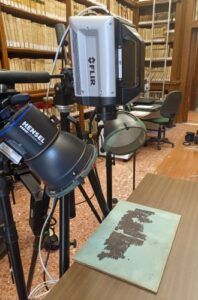
June 16: Flir thermal imaging technology is helping researchers in Italy unlock hidden text from the Herculaneum papyri, a unique collection of ancient manuscripts carbonized during the eruption of Mount Vesuvius in 79 AD. Using pulsed thermography that leverages the 2.775 MHz fast analog lock-in input port offered by advanced Flir thermal imaging cameras, scientists are recovering writing previously invisible to the naked eye while also gaining new insight into the fragile internal structure of the documents. All images are sourced from S. Ceccarelli et al., SciRep 15, 34466 (2025).
The vital project is being led by researchers at the Institute of Heritage Science, part of the National Research Council of Italy (CNR), who are exploring non-destructive ways to study and preserve what remains the only surviving library from the ancient Greco-Roman world.
Discovered during excavations in the 18th century at the Villa dei Papiri in Herculaneum, the scrolls survived the volcanic eruption through carbonization caused by intense heat and burial beneath volcanic material. While this extraordinary process preserved the manuscripts, it also created major challenges for historians and conservators attempting to read and protect them.
Many of the papyri were mechanically unrolled centuries ago and mounted to supporting boards. However, the resulting fragments are extremely fragile, often heavily layered, and in many cases almost unreadable.
Conventional Imaging Falls Short
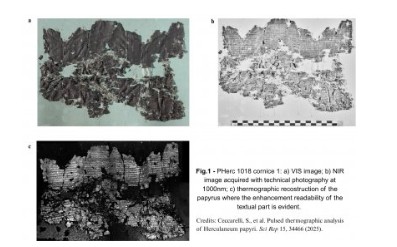
One of the principal challenges facing researchers is that both the carbonized papyrus substrate and the ink are black, making differentiation extremely difficult using conventional imaging methods as the contrast in the visible range is lost. Other more sophisticated techniques like X-ray can work, particularly in combination with artificial intelligence, but are more complex and expensive, requiring transportation of the papyri to special labs where these techniques are available.
To address these challenges, conservators turned to pulsed thermography, a technique that combines controlled light excitation with high-speed thermal imaging. The method works by illuminating the papyrus with a short pulse of light and recording the resulting thermal response over time.
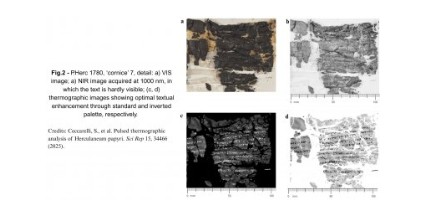
Surface inscriptions become visible almost immediately in the first few infrared frames after excitation because the ink absorbs light differently to the surrounding papyrus material. As heat propagates through the sample over the following seconds, deeper structural details and underlying features begin to emerge. This time-based thermal behavior provides researchers with a way to distinguish writing from substrate material.
Advanced Thermal Imaging
Central to the project is the use of Flir X-Series thermal imaging cameras. Combining high-speed, high-sensitivity infrared imaging with advanced thermal management capabilities, the cameras are ideal for scientific and research environments where precision and data integrity are vital.
Operating in the mid-wave infrared spectrum, Flir X-Series cameras enabled researchers to capture rapid thermal events with exceptional sensitivity, allowing subtle temperature differences between inked and non-inked areas of the papyri to become visible during pulsed thermography analysis. The X-Series features a fast analog lock-in input port designed to receive external reference signals, enabling high-speed thermal analysis at a sampling rate of 2.775 MHz. This capability allows researchers to detect faint signals or minute temperature differences in materials.
The researchers used dual flash lamps to generate controlled excitation while limiting temperature increases within the papyri to 2-3°C, well below any level considered harmful to the ancient material. Special filtering systems also prevented ultraviolet exposure and minimized unwanted infrared reflections.
According to the project team, the high sensitivity, spatial resolution and advanced recording capabilities of the Flir X-Series proved particularly important when identifying fine thermal contrasts and preserving image clarity throughout the acquisition process.
The ability to stream and record thermal data continuously without dropped frames also supported detailed post-processing and analysis using Flir Research Studio software.
Notably, the method remains entirely non-contact and non-destructive, a critical requirement when working with fragile cultural heritage artefacts that cannot be physically manipulated or removed from their historical supports.
Beyond Text Recovery
While the primary objective of the project involves revealing hidden text, pulsed thermography also provides valuable structural information for conservation specialists.
As heat diffuses through the papyrus over longer timescales, the thermal data begins to reveal features such as fiber patterns, overlapping layers, and adhesion points between the papyrus and its supporting board. These details help conservators better understand the physical condition of the manuscripts and identify areas where deterioration or detachment may be occurring.
The ability to investigate both writing and substrate morphology from the same thermal dataset provides significant advantages for restoration planning and long-term preservation strategies. The technique is particularly useful because some regions of the manuscripts contain multiple compressed layers created during the historical unrolling process. In these areas, underlying sections remained attached rather than separating cleanly, creating a complex structure that is difficult to analyze using traditional imaging methods.
The researchers also noted that some competing technologies can involve bulkier equipment, more restrictive positioning requirements, or lower image definition when examining layered material.
Future Potential
One of the remaining challenges involves identifying text located on the reverse side of the papyri or buried within heavily layered sections where only limited excitation light can penetrate. Although possible to detect residual thermal information from deeper layers, the resulting signals become increasingly weak and blurred as heat diffuses through the material.
To help overcome these limitations, the CNR team is now exploring the use of AI-based processing techniques. AI-assisted analysis could further enhance differentiation between the ink and the papyrus substrate, potentially improving readability and supporting future interpretation of the texts.
Whatever the future holds, the team is confident that pulsed thermography is set to become an increasingly valuable complementary tool alongside other advanced heritage science techniques. This exciting project has demonstrated the growing role of Flir thermal imaging technology in scientific research and preservation. By combining high-speed thermal acquisition with advanced analysis methods, researchers are now able to study some of the world’s most fragile historical artefacts in ways that were previously impossible.