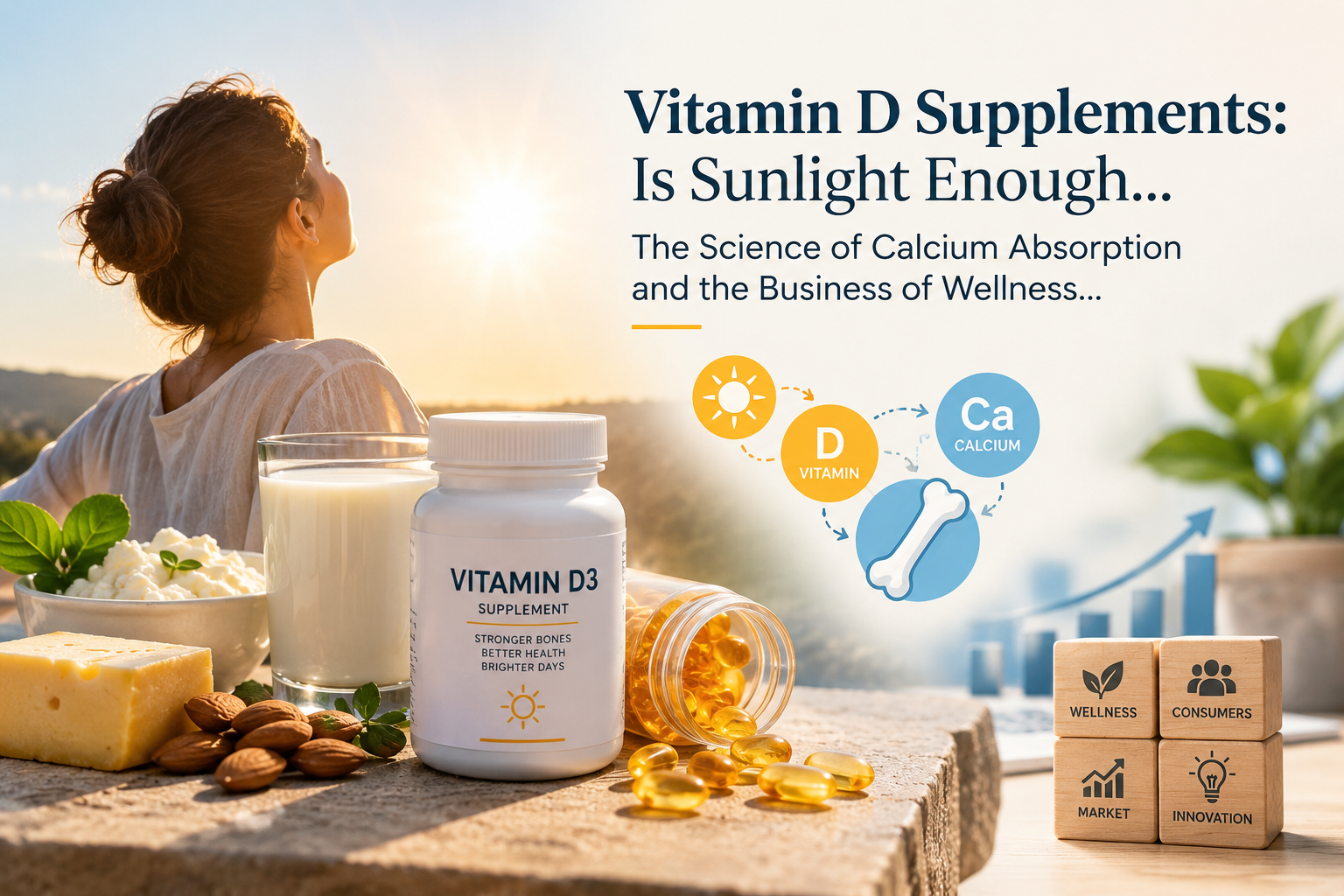
Oct 22: India receives abundant sunshine, yet vitamin D supplements have become a familiar part of the country’s wellness market. From daily tablets and capsules to high-dose sachets and calcium combinations, these products are promoted as convenient ways to support bone health, muscle function and overall wellbeing.
But if sunlight helps the body produce vitamin D, why are so many people buying supplements?
The answer goes beyond the weather. Indoor working hours, limited outdoor activity, dietary habits and individual differences can all affect vitamin D levels. Meanwhile, wellness brands are turning growing awareness of nutritional deficiencies into a commercial opportunity.
The real question is not whether vitamin D is important. It is whether everyone needs a supplement, how much sunlight can actually help and where the science ends and marketing begins.
The Sunshine Paradox: Why Vitamin D Deficiency Can Occur in India
Sunlight plays an important role in vitamin D production. When ultraviolet B (UVB) rays reach exposed skin, they trigger a process through which the body produces vitamin D3. The vitamin is then processed by the liver and kidneys into forms the body can use.
However, living in a sunny country does not automatically guarantee adequate vitamin D levels.
Consider an office worker who leaves home early, spends most of the day indoors and returns after sunset. Despite living in a warm climate, that person may receive limited exposure to the UVB rays needed for vitamin D production. Students, remote workers and people who spend much of their time indoors may face similar challenges.
Skin pigmentation, age, clothing, season, air pollution and the amount of skin exposed can also influence vitamin D production. Ordinary window glass blocks most of the UVB radiation needed for vitamin D synthesis, so sitting beside a sunny window is not an effective substitute for outdoor exposure.
A 2025 expert consensus published in the Indian Journal of Endocrinology and Metabolism, developed by 41 endocrinologists, examined vitamin D deficiency prevention and treatment in India. It highlighted concerns about low vitamin D levels and differences in the thresholds used to assess vitamin D status.
The findings reinforce an important point: sunshine alone cannot tell us whether a person has adequate vitamin D. Lifestyle, diet and individual health circumstances matter too.
Is Sunlight Alone Enough?
Sunlight is a natural source of vitamin D, but there is no universal rule for how long everyone should spend outdoors to produce enough.
Vitamin D production varies with skin pigmentation, age, time of day, season, geographical location, cloud cover and air pollution. People with darker skin generally produce vitamin D less efficiently from the same amount of UVB exposure than people with lighter skin.
This makes blanket advice to spend a fixed number of minutes in the sun difficult to apply to everyone.
There is also a health trade-off. Excessive ultraviolet exposure can damage the skin, so deliberately spending long periods in unprotected sunlight is not a risk-free solution.
Food can contribute to vitamin D intake, although relatively few foods naturally contain substantial amounts. Oily fish, egg yolks and certain fortified products are useful sources.
For some people, a balanced diet and ordinary outdoor activity may help meet their nutritional needs. Others, particularly those with risk factors or diagnosed deficiency, may need supplementation under appropriate medical guidance.
The important distinction is that sunlight helps the body produce vitamin D, but it does not guarantee adequate levels in every individual.
The Calcium Connection: Why Vitamin D Matters
Vitamin D has an important role in helping the body absorb calcium.
Calcium is essential for healthy bones and teeth. It also supports muscle contraction and normal nerve function. But consuming calcium-rich foods is only part of the process; the body must also absorb and regulate calcium effectively.
Vitamin D helps the intestine absorb calcium and supports the regulation of calcium and phosphate, both of which are needed for normal bone development and maintenance.
When vitamin D deficiency is severe or prolonged, calcium absorption can decline. This may contribute to rickets in children and osteomalacia, a condition involving poorly mineralised bones, in adults.
This relationship explains why vitamin D and calcium frequently appear together in supplement advertisements.
However, the science is often simplified in ways that can mislead consumers. Taking extra calcium and vitamin D does not automatically make everyone’s bones stronger. The benefits depend on existing nutritional intake, age, vitamin D status and underlying health conditions.
Someone who already obtains enough calcium and vitamin D may not need additional supplements. A person with a confirmed deficiency, on the other hand, may require a specific treatment plan.
Vitamin D helps the body absorb calcium, but that does not mean everyone needs to buy both supplements.
How Wellness Marketing Turns Vitamin D into a Daily Essential
Vitamin D is a genuine nutritional necessity, making it an attractive product for wellness brands. The problem arises when sound health information becomes a message that everyone should be taking supplements.
Turning everyday tiredness into a sales opportunity
Advertisements and online wellness content often connect fatigue, muscle discomfort and low energy with vitamin D deficiency.
These symptoms can occur in people with low vitamin D levels, but they can also have many other causes. Feeling tired does not automatically mean a person needs a vitamin D tablet.
Responsible marketing should explain risk factors without encouraging consumers to diagnose themselves based on vague symptoms.
The immunity promise
Vitamin D plays a role in normal immune function, making it a popular ingredient in products marketed for everyday wellness.
However, a nutrient’s role in the immune system does not prove that taking extra amounts will prevent infections or guarantee better immunity.
When advertising turns a biological function into a broad promise of disease prevention, consumers may develop unrealistic expectations about what a supplement can deliver.
The calcium and bone-strength message
Combining calcium and vitamin D can be useful for people who need both nutrients. It also creates a straightforward marketing message: two nutrients working together to support bone health.
But the message becomes misleading when it implies that every adult needs additional supplementation to maintain healthy bones. Adequate nutrition matters, but more is not always better.
High doses and the impression of greater effectiveness
Some products prominently advertise high-dose vitamin D sachets or capsules. Consumers may assume that a higher dose works faster or offers superior benefits.
In reality, the appropriate dose depends on individual needs. High-dose regimens may be prescribed to treat a diagnosed deficiency, but they should not be adopted casually.
Excessive vitamin D can cause calcium levels in the blood to rise dangerously, potentially leading to kidney problems and other complications.
A bigger number on the packaging is not proof of a better product.
The daily supplement habit
Social media influencers, online shopping platforms and wellness subscriptions have made supplements easier to discover and purchase. Vitamin D can become part of a daily routine alongside multivitamins, protein powders and other wellness products.
Convenience is not inherently a problem. The concern is whether people are buying products because they need them or because repeated marketing has made supplementation feel compulsory.
For brands, the distinction matters. Building a business around clear information and appropriate use can support consumer trust more effectively than relying on anxiety about deficiency.
What Does the Research Actually Say?
The 2025 Indian expert consensus provides a useful clinical perspective on vitamin D deficiency. It addresses prevention, assessment and treatment in the country’s context, while recognising that individual circumstances matter when deciding how to manage vitamin D levels.
Other major studies also highlight the difference between correcting a deficiency and preventing disease in generally healthy people.
The VITAL trial, published in The New England Journal of Medicine in 2019, studied vitamin D supplementation at 2,000 IU daily among generally healthy older adults. It found that supplementation did not significantly reduce invasive cancer or major cardiovascular events during the trial.
This does not mean vitamin D is unimportant. It means that treating inadequate vitamin D levels and taking supplements to prevent major diseases are two different questions.
The evidence supports the importance of vitamin D for normal bodily functions and the treatment of deficiency when appropriate. It does not justify treating supplements as a universal solution for fatigue, immunity or disease prevention.
India’s Vitamin D Supplement Market: Opportunity and Responsibility
Concern about nutritional deficiencies, changing work patterns and growing interest in preventive healthcare create opportunities for vitamin D supplement manufacturers and retailers in India.
Products are available in tablets, capsules, drops, powders and combinations with calcium or other nutrients. Pharmacies, online marketplaces, direct-to-consumer brands and healthcare professionals all influence purchasing decisions.
Businesses can build a more credible market through several approaches:
-
Clearer labelling: Explain the amount of vitamin D per serving and distinguish routine nutritional products from high-dose formulations.
-
Better consumer education: Explain the relationship between vitamin D, calcium and bone health in accessible language.
-
Transparent product information: Communicate ingredients, dosage and appropriate use clearly.
-
Responsible marketing: Avoid unsupported promises about immunity, energy, ageing or disease prevention.
-
Regulatory compliance: Ensure product composition, labelling and claims comply with applicable Food Safety and Standards Authority of India requirements.
There is a genuine commercial opportunity in meeting nutritional needs. However, brands that rely on fear-based messages risk undermining consumer trust.
The strongest long-term approach is to help people understand their needs rather than convince everyone that they have a deficiency.
How Can Consumers Know Whether They Need Vitamin D?
People who spend little time outdoors, older adults, individuals with darker skin, those with certain absorption disorders and people with particular medical conditions may face a greater risk of inadequate vitamin D status.
However, risk factors do not automatically confirm a deficiency.
A healthcare professional can determine whether a blood test measuring 25-hydroxyvitamin D is appropriate, taking into account medical history, symptoms and other relevant factors. Testing is not necessarily required for every healthy person.
Dosage also matters. The US National Institutes of Health identifies 4,000 IU per day from all sources as the tolerable upper intake level for most adults. This is a safety limit, not a recommended daily target. Clinicians may prescribe different doses for a limited period when treating a deficiency.
A sensible approach includes maintaining a balanced diet, engaging in appropriate outdoor activity, protecting the skin from excessive UV exposure and seeking professional advice when supplementation may be necessary.
Beyond the Bottle: What Vitamin D Really Teaches Us
Vitamin D illustrates how a genuine nutritional need can become a major consumer wellness category. It is essential for calcium absorption and healthy bones, and supplements can play an important role when dietary intake or vitamin D status is inadequate.
But the existence of a real health concern does not mean every person needs the same solution.
Sunlight can help the body produce vitamin D, yet it does not guarantee adequate levels for everyone. Supplements can fill a nutritional gap, but they should not be treated as a universal requirement or a shortcut to better health.
For consumers, the goal should be to understand their nutritional needs rather than follow every wellness trend. For businesses, the opportunity is to provide reliable products and communicate their benefits honestly.
Ultimately, the best message is not that everyone needs another tablet. It is that understanding the relationship between sunlight, vitamin D and calcium helps people make better choices—and gives the wellness industry a chance to build trust through evidence rather than anxiety.