Mumbai, Oct 22: Maharashtra’s sugar and ethanol industry is facing mounting financial uncertainty following the Centre’s decision to restrict ethanol procurement from sugarcane juice, sugar syrup and B-heavy molasses for the upcoming ethanol supply year, raising concerns over investments, factory operations and farmer incomes.
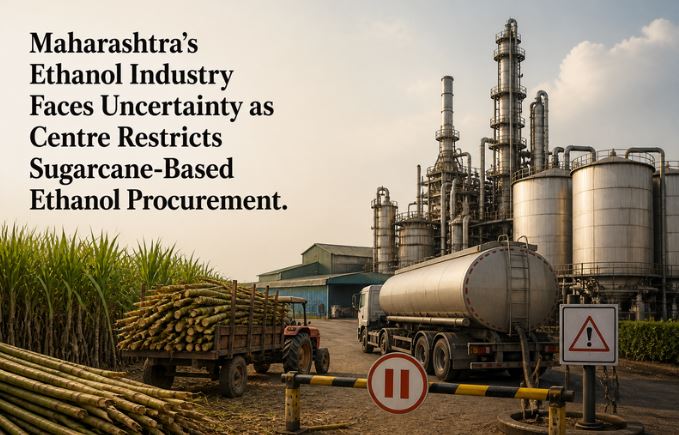
Representational Image
The procurement guidelines issued on October 16 by oil marketing companies (OMCs) have triggered apprehension among sugar mill operators and independent distillery owners, many of whom expanded their production capacities in response to the government’s ethanol-blending programme.
The policy shift is aimed at ensuring adequate domestic sugar availability. However, industry representatives warn that restricting procurement to ethanol produced from C-heavy molasses could make several existing projects financially unviable, potentially leaving factories struggling to service loans and recover their investments.
Heavy Investments at Risk
India’s ethanol industry witnessed substantial expansion after the government encouraged producers to support the target of blending 20 per cent ethanol with petrol, with the broader objective of reducing dependence on imported crude oil and conserving foreign exchange.
According to industry representatives, nearly Rs 1 lakh crore has been invested in the country’s ethanol sector. They estimate that investments worth around Rs 40,000 crore in sugarcane-based ethanol production could be exposed to significant financial risks under the revised procurement framework.
India’s total installed ethanol manufacturing capacity stands at approximately 2,000 crore litres annually, including around 848 crore litres of grain-based capacity, according to figures cited by industry sources.
Maharashtra, one of the country’s leading sugar-producing states, has also witnessed substantial investment in distilleries and ethanol-processing facilities. A senior sugar cooperative chairman said the state has 16 standalone and grain-based distilleries with a combined annual production capacity of approximately 56 crore litres.
The cost of setting up a grain-based distillery with a daily capacity of 60 kilolitres is estimated at Rs 120 crore to Rs 135 crore, while a 30-kilolitre facility may require an investment of Rs 50 crore to Rs 60 crore.
Industry stakeholders argue that such capital-intensive projects require predictable procurement policies and adequate market access to remain commercially sustainable.
Capacity Utilisation Remains a Concern
Data from the Maharashtra State Cooperative Sugar Factories Federation Ltd indicates that sugar factories in the state have an installed ethanol production capacity of approximately 3,750 million litres.
During the 2025-26 season, these factories supplied around 1,250 million litres, utilising roughly 30 per cent of their installed capacity.
Industry representatives fear that the latest restrictions could further reduce utilisation levels, particularly at facilities designed to process sugarcane juice, syrup and B-heavy molasses.
They also contend that ethanol production exclusively from C-heavy molasses may not generate sufficient returns under prevailing market conditions, although the financial impact is likely to vary depending on production costs, plant configuration and access to alternative feedstocks.
Sugar Production Versus Ethanol Expansion
The Centre’s decision reflects the challenge of balancing the country’s sugar requirements with its ambitions for expanding ethanol blending.
According to estimates by a high-level committee chaired by Maharashtra Chief Minister Devendra Fadnavis, the state is expected to have approximately 99 million tonnes of sugarcane available for crushing during the 2026-27 season.
Sugar production has been projected at around 9.6 million tonnes after diverting an estimated 1.5 million tonnes of sugar towards ethanol production.
Industry participants acknowledge the importance of maintaining adequate domestic sugar supplies but argue that abrupt changes in procurement policy could undermine the investments made to build ethanol production capacity.
Industry Leaders Warn of Financial Fallout
Harshvardhan Patil, chairman of the National Federation of Cooperative Sugar Factories and a former Maharashtra Cooperation Minister, expressed concern over the potential consequences for banks, sugar mills and farmers.
He said government encouragement had prompted sugar factories to establish distilleries and invest heavily in ethanol projects. According to Patil, ethanol blending has helped save approximately Rs 2 lakh crore in foreign exchange and generated payments of around Rs 1.75 lakh crore for farmers.
He warned that the financial stability of the sector could come under pressure if existing facilities are unable to operate profitably, raising concerns about potential non-performing assets in the banking system.
B.B. Thombare, president of a sugar mills association, also criticised the policy shift, arguing that the ethanol economy had been developed through years of investment and policy support.
He maintained that temporary fluctuations in sugar availability should be addressed through a balanced approach that protects domestic consumers without destabilising the long-term development of the ethanol industry.
Mills Seek Support for Multi-Feed Distilleries
Amid the uncertainty, cooperative sugar mills are seeking government assistance to convert existing distilleries into multi-feed facilities capable of processing maize and other grains alongside sugar-based feedstocks.
Such upgrades could allow producers to diversify their raw material sources, improve year-round operations and reduce dependence on a single procurement category.
However, converting plants would require additional capital expenditure, technical modifications and access to reliable supplies of alternative feedstocks. Smaller mills and financially stretched cooperatives could face particular difficulties in financing the transition.
Industry representatives are therefore urging the Centre to reconsider the procurement framework and provide a transition mechanism for projects established under earlier policy incentives.
The coming months will be crucial for Maharashtra’s sugar and ethanol sector as mills assess the viability of their operations under the revised rules. For an industry that has invested heavily in support of India’s fuel-blending ambitions, the immediate challenge is to reconcile the government’s objective of protecting sugar supplies with the need to maintain financial stability, safeguard farmers’ interests and preserve the capacity created for ethanol production.