
In this story
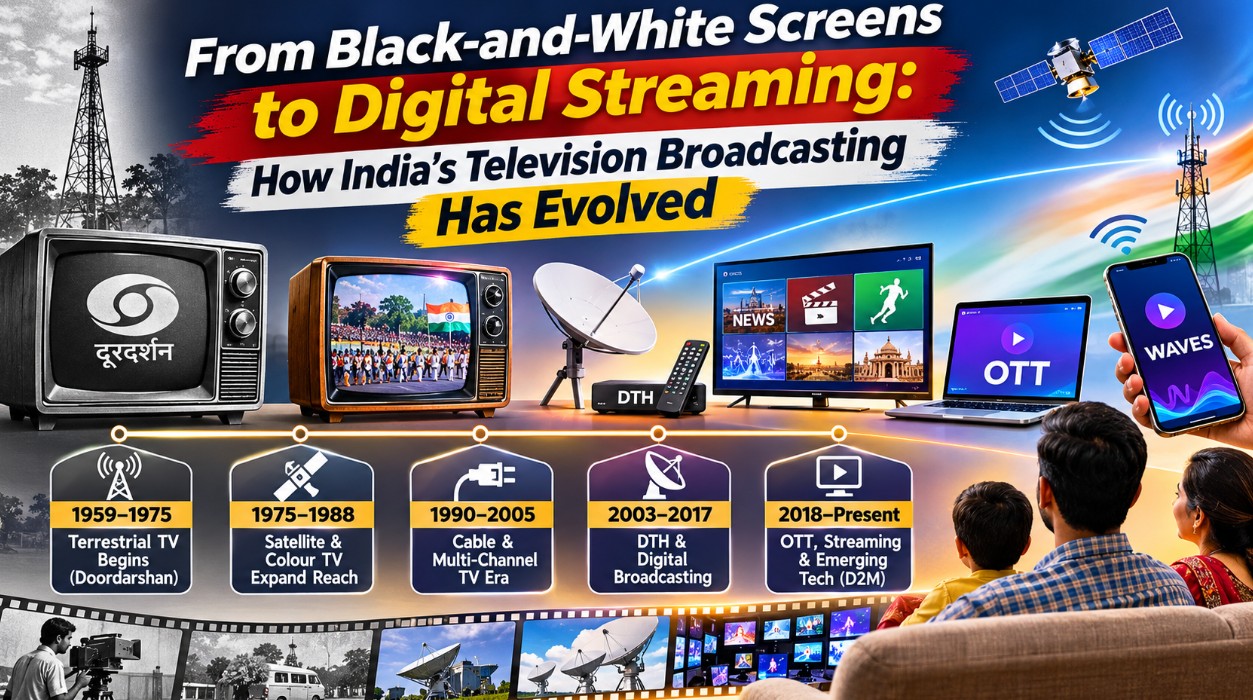
From its first experimental transmission in 1959 to satellite television, DTH and OTT platforms, India’s broadcasting ecosystem has undergone a remarkable technological transformation, expanding access to information, education and entertainment.
India’s television broadcasting industry has travelled a remarkable journey over the past six decades, evolving from a limited experimental service into a vast, multi-platform communication network connecting millions of households. What began with a modest television transmission in Delhi in 1959 has expanded into an ecosystem encompassing terrestrial broadcasting, satellite television, cable networks, Direct-to-Home (DTH) services and internet-based streaming platforms.
As the world observes World Television Day on November 21, India’s broadcasting transformation highlights how technological innovation has reshaped the way people access news, education, entertainment and public information.
Recognising television’s influence on global communication and public awareness, the United Nations General Assembly proclaimed November 21 as World Television Day in 1996. The observance underlines television’s continuing role in informing, educating and connecting societies.
The Beginning: India’s Television Journey Started in 1959
India’s television broadcasting history began on September 15, 1959, when an experimental television service was launched in Delhi by All India Radio (AIR) under the Ministry of Information and Broadcasting.
Operating through a makeshift studio and a small transmitter, the service initially covered a limited geographical area. It became a regular television service in 1965, marking the beginning of a new era in India’s mass communication landscape.
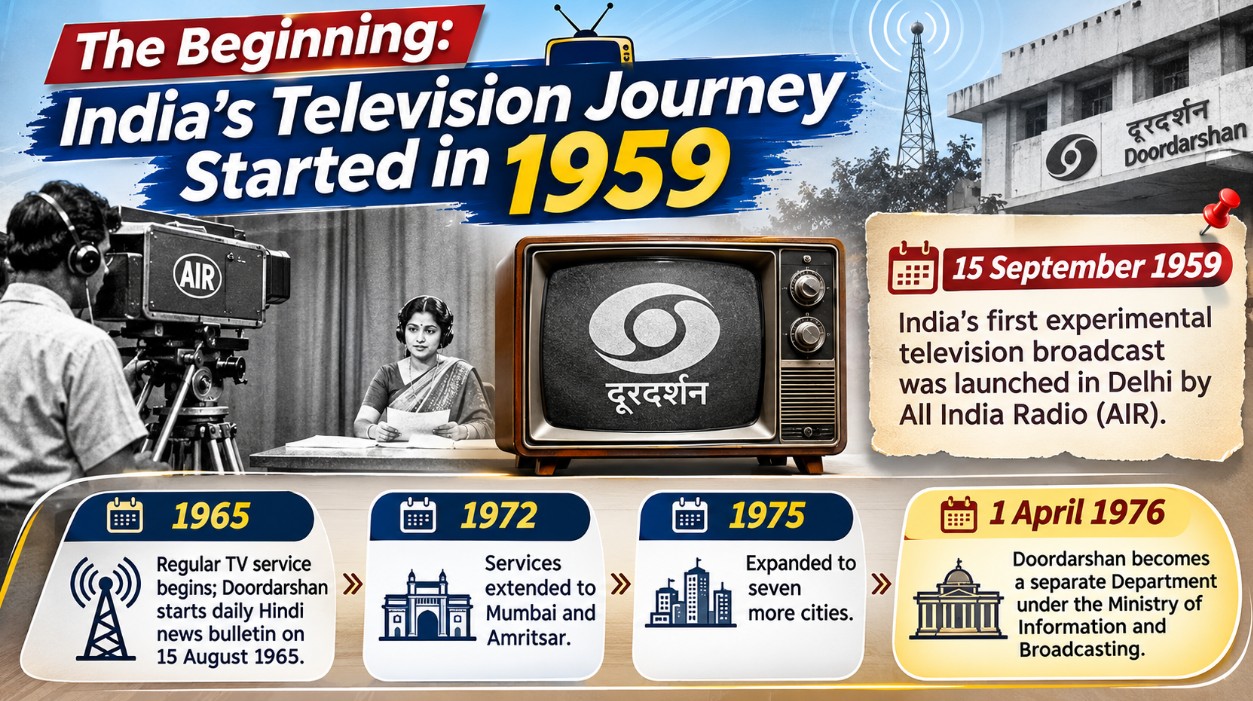
On August 15, 1965, Doordarshan began transmitting daily Hindi news bulletins. Television services subsequently expanded to Mumbai and Amritsar in 1972, followed by seven additional cities by 1975.
A major institutional change came on April 1, 1976, when Doordarshan separated from All India Radio and became an independent department under the Ministry of Information and Broadcasting.
During this early phase, television signals were transmitted through analogue terrestrial networks. Ground-based transmitters sent signals through radio waves, which household television sets received using indoor or outdoor antennas.
However, the technology had significant limitations. Signal strength depended on distance from transmitters and could be affected by buildings, hills and other physical obstructions. Channel capacity was also restricted, with each assigned frequency generally carrying one television programme.
These challenges created the need for more efficient broadcasting technologies capable of reaching larger geographical areas.
Satellite Technology Transforms Broadcasting
The mid-1970s marked a turning point in India’s television expansion, as satellite communication opened new possibilities for reaching remote and underserved communities.
One of the most significant initiatives was the Satellite Instructional Television Experiment (SITE), conducted between August 1975 and July 1976.
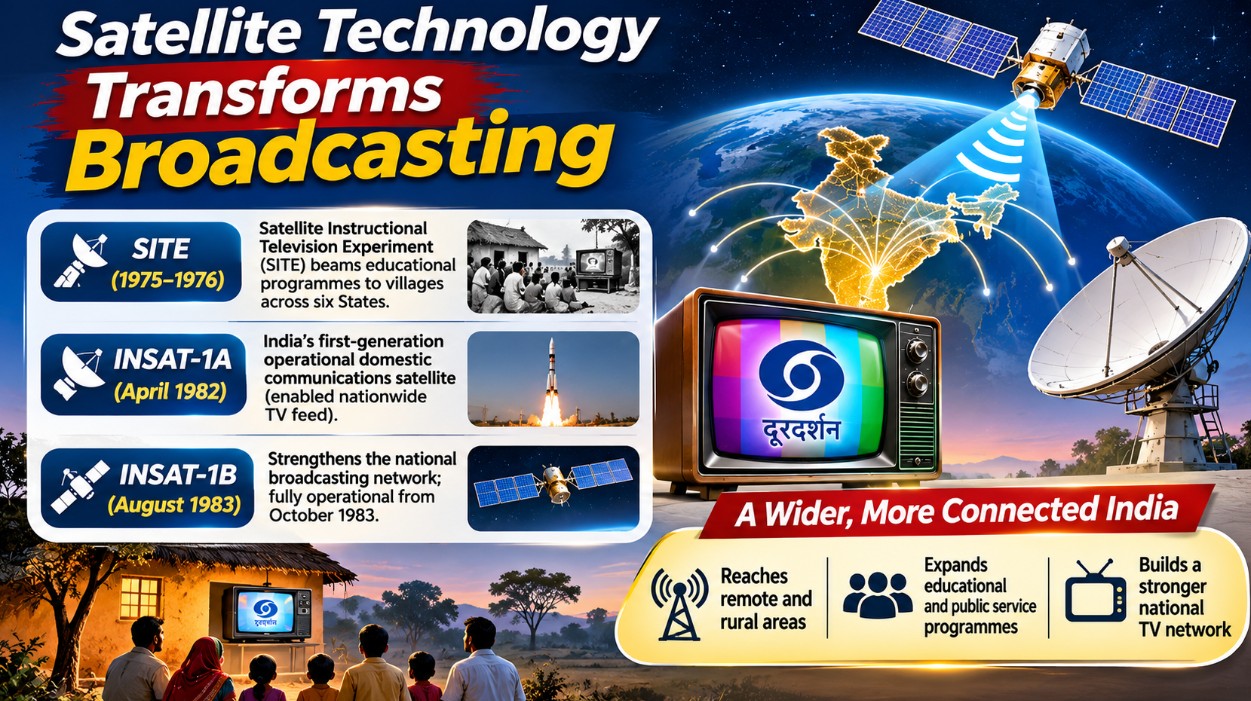
Using satellite technology, the experiment delivered educational programming to villages across six states. Its objective was to demonstrate how television could support education, agricultural awareness and socio-economic development.
SITE established the potential of satellite broadcasting to overcome geographical barriers and strengthened the role of television as an instrument of public communication.
India’s satellite broadcasting capabilities received another major boost through the Indian National Satellite (INSAT) programme.
INSAT-1A, launched in April 1982, was India’s first-generation operational domestic communications satellite, although it was subsequently abandoned in 1983. INSAT-1B, launched in August 1983, became fully operational in October that year, strengthening the country’s satellite communication infrastructure.
The development enabled a common programme feed from Delhi to regional Doordarshan stations, improving nationwide connectivity.
Colour Television Opens a New Chapter
Alongside satellite expansion, the introduction of colour broadcasting fundamentally changed the television viewing experience.
Doordarshan’s first colour telecast took place on August 15, 1982, coinciding with the launch of its National Programme. The transition gained widespread public attention through the live telecast of the Asian Games held in New Delhi in November 1982.
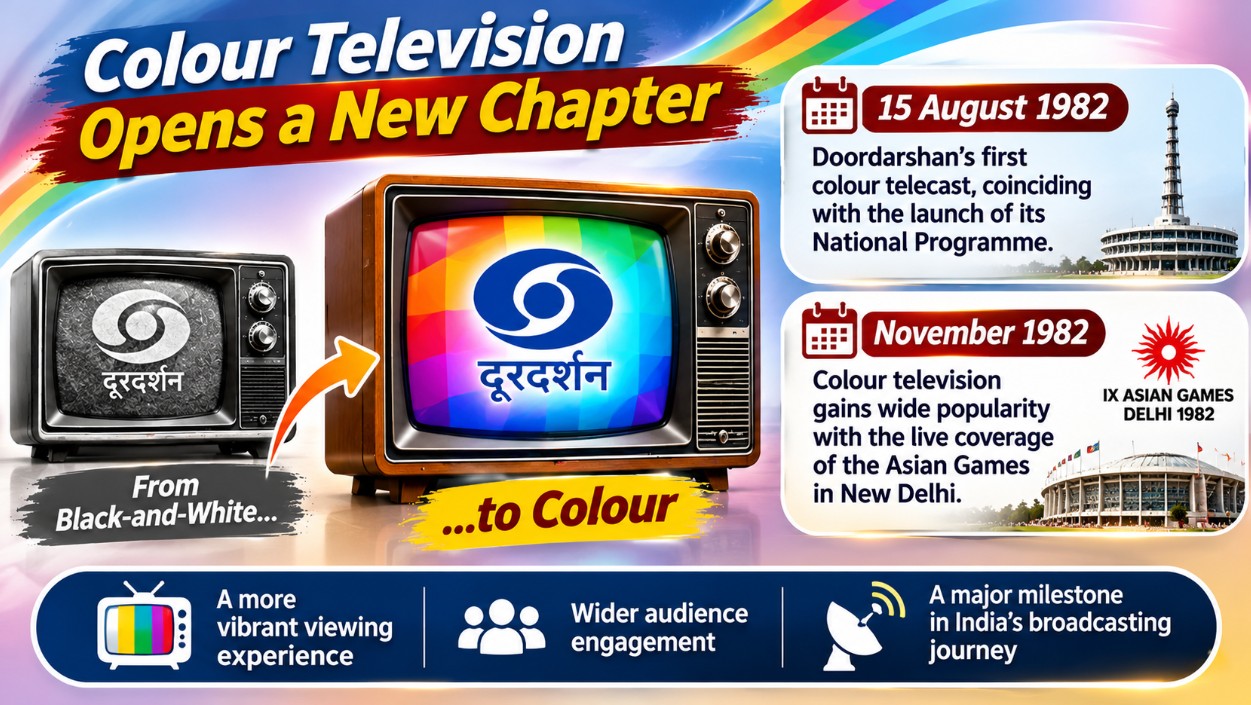
The shift from black-and-white to colour television represented an important milestone in Indian broadcasting, making television programmes more engaging and visually appealing.
Satellite communication also expanded broadcasting possibilities. Signals transmitted from Earth stations could be received by satellites and retransmitted over extensive geographical areas.
The process involves three key stages: uplinking signals from an Earth station, receiving and retransmitting them through satellite transponders, and downlinking them to receiving stations or distribution networks.
This combination of satellite connectivity and terrestrial infrastructure laid the foundation for a broader national broadcasting network.
The 1990s: Cable and Satellite Television Expand Viewer Choice
The 1990s brought another major transformation as international and private television channels entered the Indian market.
International broadcasters such as CNN, followed by Star TV, began reaching Indian audiences. Zee TV and other domestic broadcasters, including Sun TV, further accelerated the growth of the multi-channel television market.
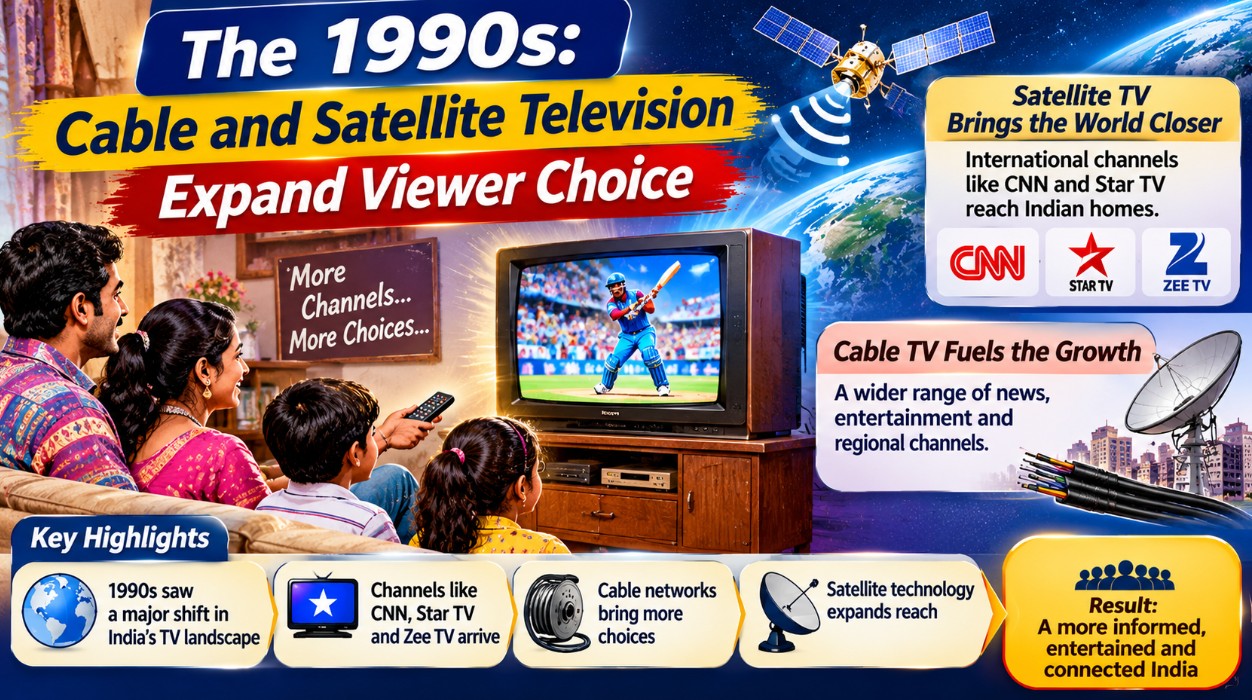
Cable television became an important distribution mechanism during this period.
Broadcasters transmitted programmes to satellites, which retransmitted the signals towards Earth. Local cable operators received these signals through dish antennas installed at their head-end facilities, processed the channels and distributed them to households through cable networks.
This system significantly increased the variety of content available to viewers, introducing more news, sports, entertainment and regional-language programming.
However, cable distribution depended on physical network infrastructure, making expansion into remote and geographically difficult locations challenging.
The need for a more flexible distribution model encouraged the development of Direct-to-Home television services.
DTH and Digital Broadcasting Expand Access
India entered a new phase of television distribution with the introduction of commercial DTH services.
Dish TV launched India’s first commercial DTH service in October 2003. In December 2004, Prasar Bharati introduced DD Direct Plus, now known as DD Free Dish.
The free-to-air platform enabled households to access television channels without paying a monthly subscription, expanding broadcasting access, particularly in areas with limited cable connectivity.
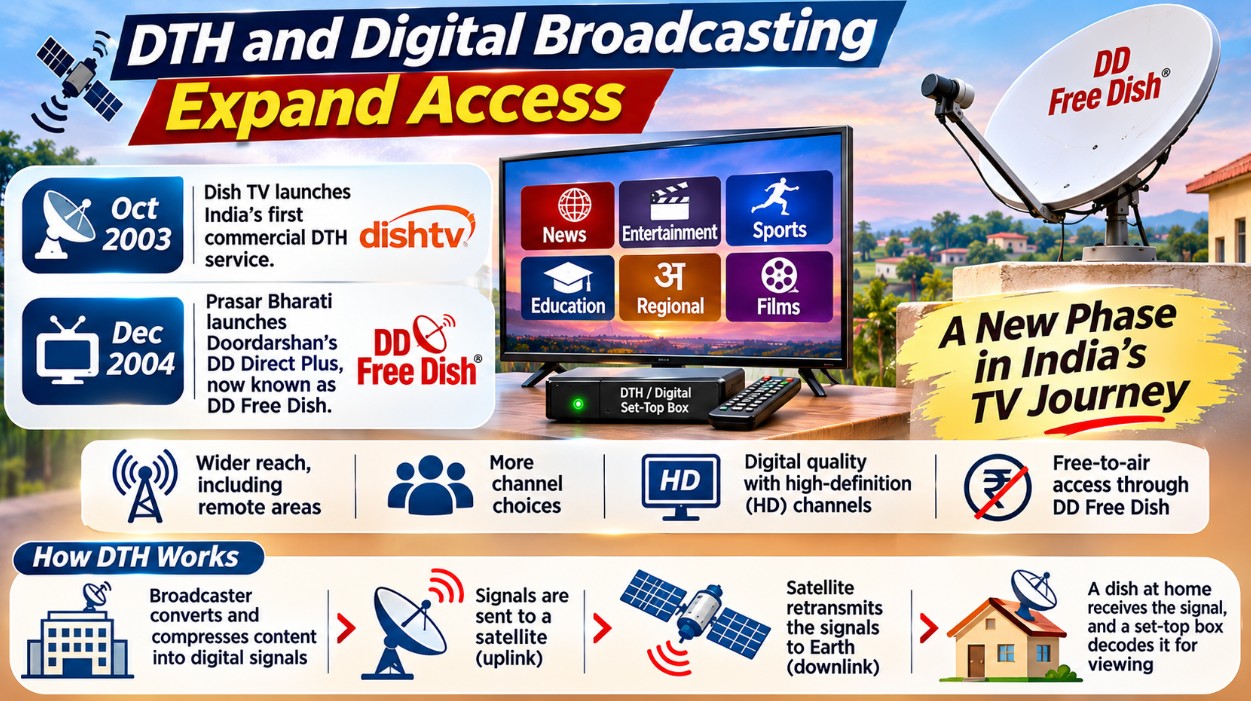
Unlike cable television, DTH delivers satellite signals directly to individual households through dish antennas installed at subscribers’ premises.
The signals are digitally compressed and transmitted to satellites, which retransmit them towards designated coverage areas. A digital set-top box processes and decodes the received signals, allowing viewers to access television channels.
Subscription-based DTH services use encryption and authorised access systems, while free-to-air platforms such as DD Free Dish do not require monthly subscriptions.
An important technology supporting DTH broadcasting is the Ku-band, which operates within the broader 12–18 GHz radio frequency range. DTH systems commonly use frequencies around 10.7–12.75 GHz for downlink transmission.
Its relatively high operating frequencies allow smaller dish antennas to be installed at household premises. However, heavy rainfall can affect signal reception and temporarily interrupt viewing.
The Digital Revolution: OTT and Internet-Based Broadcasting
Since 2018, India’s broadcasting landscape has increasingly moved towards internet-enabled platforms, connected devices and on-demand content consumption.
Television viewing is no longer restricted to conventional television sets or scheduled programming. Smartphones, computers and Smart TVs have emerged as important platforms for accessing audio-visual content.
Over-the-top (OTT) services have transformed content delivery by enabling users to stream programmes through broadband and internet connections.
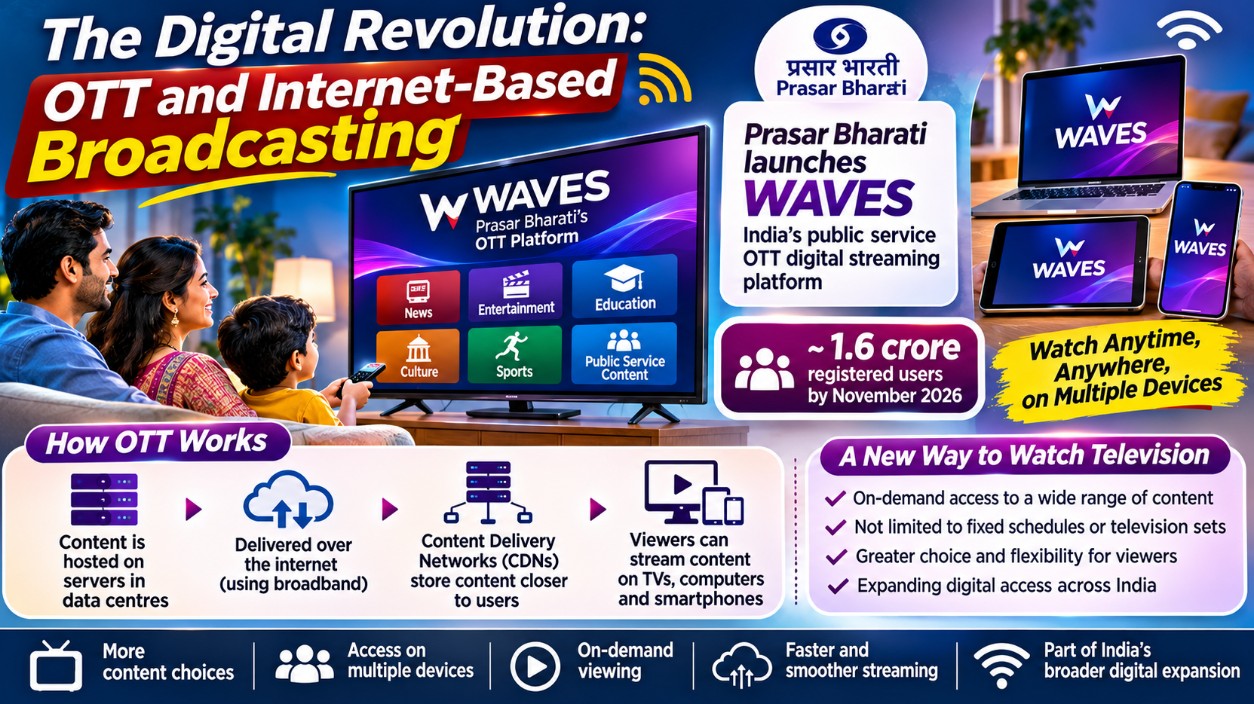
Unlike terrestrial and satellite broadcasting, which rely on transmitters and communication satellites, OTT platforms distribute content through servers hosted in data centres.
Content Delivery Networks (CDNs) further improve streaming performance by storing content on geographically distributed servers, bringing it closer to viewers and reducing delivery delays.
An important development in India’s public broadcasting ecosystem came in November 2024, when Prasar Bharati launched WAVES, its OTT digital streaming platform.
The platform brings public service broadcasting content to digital audiences. By November 2026, WAVES had recorded approximately 1.6 crore registered users.
Direct-to-Mobile Broadcasting: The Next Frontier
Another emerging technology in India’s broadcasting ecosystem is Direct-to-Mobile (D2M) broadcasting.
Unlike conventional mobile streaming, D2M uses terrestrial broadcasting infrastructure to deliver video, audio and data directly to compatible mobile devices without requiring a SIM card or mobile data connection.
The technology has the potential to support simultaneous content delivery to multiple devices, offering an alternative to internet-based streaming.
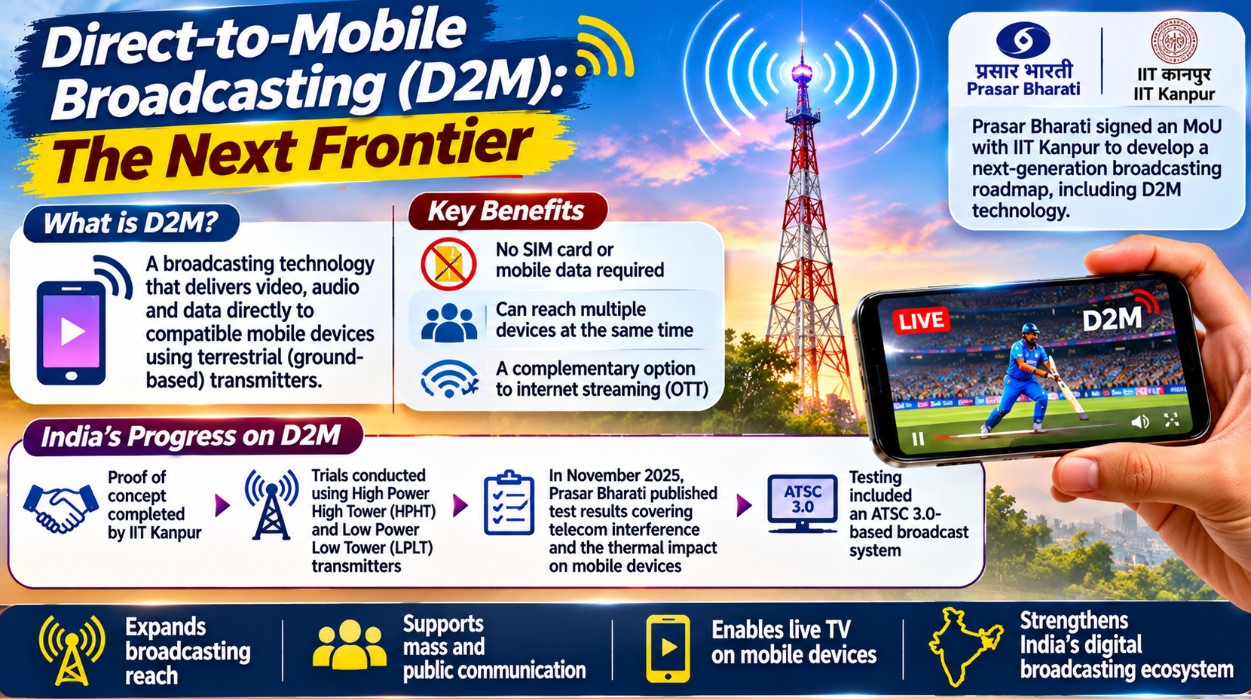
Prasar Bharati has collaborated with IIT Kanpur to explore a next-generation broadcasting roadmap. A proof of concept for D2M broadcasting was subsequently completed by IIT Kanpur.
Trials have also examined hybrid transmission models involving High Power High Tower (HPHT) and Low Power Low Tower (LPLT) transmitters.
In November 2025, Prasar Bharati published test results covering telecom interference and the thermal impact of D2M reception on mobile devices. The testing included an ATSC 3.0-based broadcasting system.
These developments indicate the growing importance of technological convergence in India’s broadcasting sector.
India’s Broadcasting Network in Numbers
The expansion of television broadcasting is reflected in the growth of India’s public and private television networks.
According to the figures cited in the Ministry of Information and Broadcasting’s backgrounder:
Doordarshan: Currently operates 35 channels, compared with 17 in 2010.
DD Free Dish: Carries 482 channels, including educational channels, compared with 59 earlier.
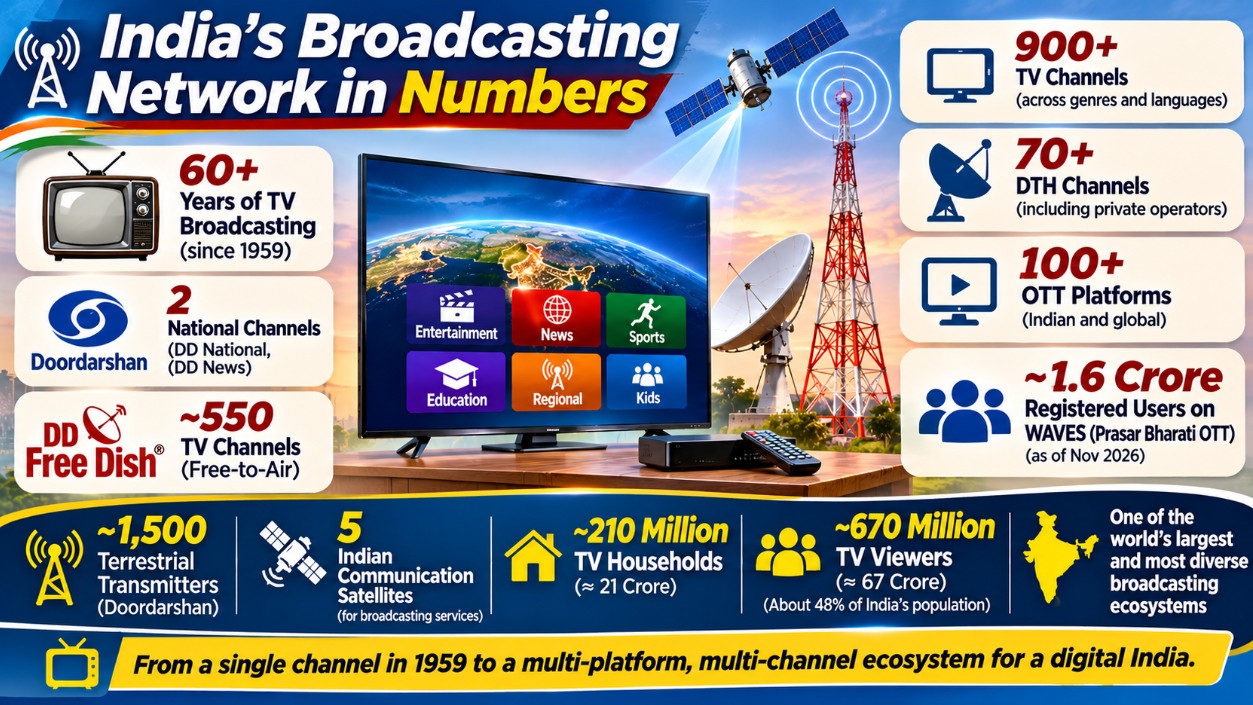
Private satellite television: The number of permitted channels increased from 603 in 2010–11 to 917 as of March 2026.
Channel availability: Of the 917 permitted channels, 908 were available for downlinking in India, comprising 342 pay channels and 566 free-to-air channels.
High-definition broadcasting: The pay-channel category included 238 standard-definition channels and 104 high-definition channels.
DTH subscribers: Private pay DTH services had 49.05 million active subscribers as of March 31, 2026.
Doordarshan’s DTH service also provides 100 per cent geographical and population coverage across the country, as stated in the backgrounder.
These figures underline the scale of India’s broadcasting infrastructure and its growing ability to serve audiences across urban, rural and remote regions.
The Road Ahead: Building a Connected Broadcasting Ecosystem
India’s television broadcasting journey reflects a transition from limited analogue transmission to an increasingly integrated digital communication environment.
Terrestrial networks, satellite services, cable distribution, DTH platforms and OTT streaming now operate as complementary components of the country’s broadcasting ecosystem.
The next phase is expected to be shaped by high-definition transmission, improved digital infrastructure, internet-based content delivery and emerging technologies such as D2M broadcasting.
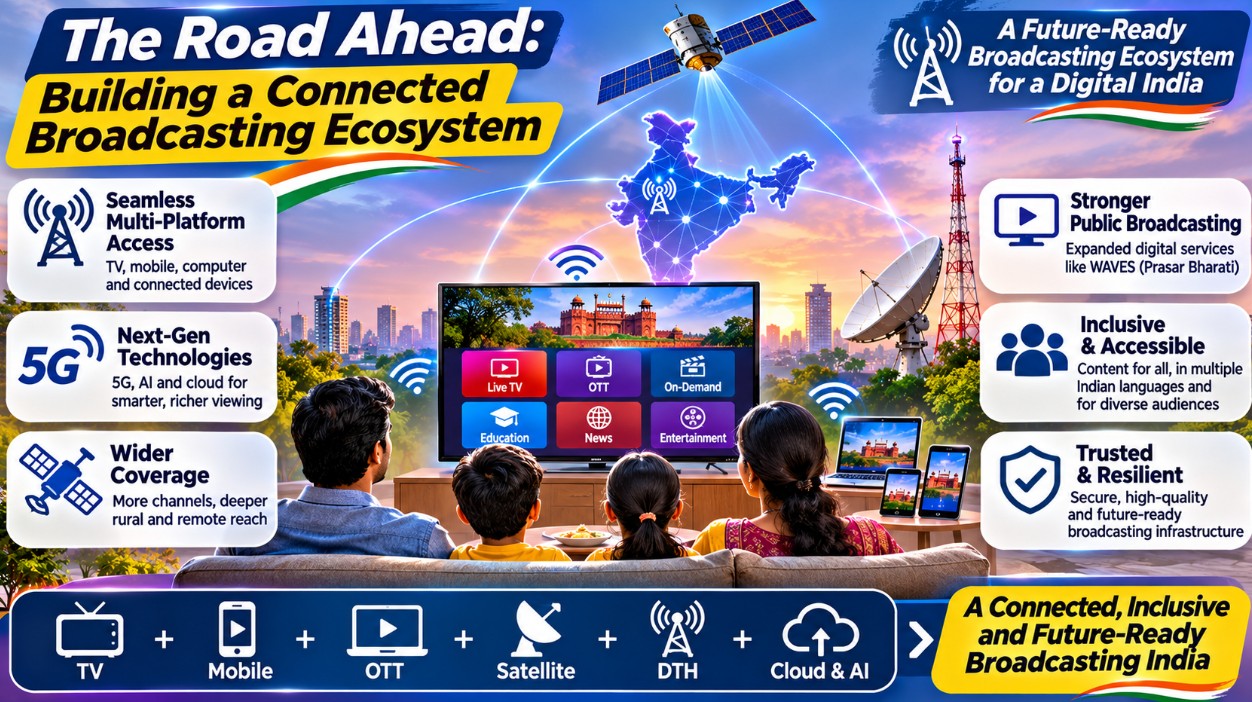
Public broadcasters and private television networks will continue to play an important role in expanding access to information, education and entertainment while responding to changing audience preferences.
From the first experimental broadcast in Delhi in 1959 to today’s connected digital platforms, television has remained a significant medium of public communication in India. Its evolution demonstrates how technology can transform access to information while bringing diverse communities closer together.
As broadcasting moves towards greater digital integration, India’s focus on innovation, connectivity and wider accessibility will be central to building a future-ready media ecosystem.