October 12, 2026
New smart glasses harvest mechanical energy from facial movements to power sensors
EVANSTON, Ill. — From blinking and smiling to jaw clenching and eyebrow raising, faces are constantly in motion — and generating tiny amounts of energy along the way.
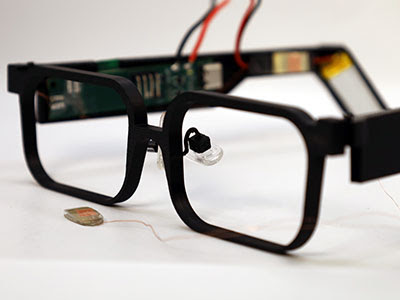
Now, Northwestern University engineers are putting that energy to work.
In a new study, the team developed a wholly new type of smart glasses equipped with tiny sensors that harvest mechanical energy from facial movements and convert it into electrical power. Even a quick blink or an artery’s faint pulsing provides enough mechanical energy to activate the highly sensitive sensors.
To put their battery-free device to the test, researchers used the glasses to detect jaw clenching, teeth tapping, blinking and eyebrow raising. Not only did the glasses distinguish these movements from everyday activities like talking and eating, but it also recognized teeth tapping with 99% accuracy and jaw clenching with 96% accuracy.
The advance could pave the way for common glasses to seamlessly monitor cardiovascular health, bruxism (inadvertent jaw clenching and teeth grinding), fatigue, eating behaviors and other activities throughout the day — without bulky batteries or regular charging.
The researchers will present this work, called GlassTENG, at 4 p.m. China Standard Time (4 a.m. EDT) on Thursday, Oct. 15 at UbiComp/ISWC 2026, a premier conference for ubiquitous, pervasive and wearable computing. “GlassTENG: Self-powered triboelectric nanogenerator based sensing of pulse, jaw and upper facial activity from everyday glasses,” is a part of the session “Eyewear Computing.” The paper is available in the Proceedings of the 2026 ACM International Symposium on Wearable Computers.
“The human face is a goldmine for health data, making everyday glasses the perfect wearable,” said Northwestern’s Nivedita Arora, who led the work. “Generally, wearables track health data, like heart rate, through the wrist. But people have to remember to wear those trackers and take them off to recharge. Our idea is based on the fact that half the population already wears glasses. We can turn those glasses into wearables without asking people to change their habits and behaviors.”
An expert in self-powered electronics, Arora is the Breed Chair Assistant Professor of Electrical and Computer Engineering and Computer Science at Northwestern’s McCormick School of Engineering, where she leads the Vasudhaiva Kutumbakam (VAK) Embodied Systems Lab. Raj Dave, Jovanis Prodanich and Yung-ching Lai — all master’s students in the VAK Embodied Systems Lab — are the study’s co-first authors.
A little static goes a long way
At the heart of the new glasses are three paper-thin devices called triboelectric nanogenerators (TENGs). Although the name sounds complicated, the phenomenon behind them is familiar: static electricity.
Anyone who has rubbed a balloon against their hair or pet a cat’s fur on a dry winter day has experienced the triboelectric effect. When two different materials come into contact and then separate, electrons can transfer from one material to the other, generating a brief electrical charge.
GlassTENG takes advantage of that same basic phenomenon. Each flexible sensor contains layers of materials that repeatedly press together and separate in response to facial movements. A blink, for example, pushes against one sensor. A clenched jaw activates another. Even the subtle pressure produced by blood pumping through an artery can push the sensors.
“As the layers touch and separate, they generate a tiny voltage,” Arora said. “That means the very movement being measured supplies the mechanical energy needed to power its detection. In other words, a blink helps power the sensor that detects the blink.”
Three sensors, many signals
To capture as much information as possible, Arora and her team positioned three sensors at strategic locations around the glasses frame. One sits at the bridge of the nose, near the angular artery and muscles surrounding the eyes. There, it can pick up the pulse as well as blinking and eyebrow movements. Another sensor sits near the temple, where it detects the superficial temporal artery along with jaw movements. A third sensor sits closer to the ear, where it detects movements from chewing and clenching.
Together, the three sensors give the glasses different vantage points from which to “feel” the face’s movements. And the sensors are sensitive to a range of forces. An arterial pulse — the lightest force the researchers tested — generated electrical signals of about 50 to 100 millivolts. Blinks and eyebrow raises produced roughly 200 to 500 millivolts. Stronger jaw movements, including chewing and clenching, generated signals as high as 1.5 volts.
“These differences give various facial activities their own recognizable electrical signatures,” Arora said.
While wearing GlassTENG, 20 participants performed six activities: blinking, raising their eyebrows, clenching their teeth, tapping their teeth, eating and talking. The research team then used machine-learning algorithms to analyze patterns in the electrical signals and determine which activity each participant performed. Across the six activities, the system achieved 93.8% accuracy.
“One of the most exciting possibilities is using this technology to turn unconscious behaviors into opportunities for meaningful behavior,” said study coauthor Nabil Alshurafa, an associate professor of preventive medicine, computer science and electrical and computer engineering at Northwestern, where he has appointments at Northwestern University Feinberg School of Medicine and McCormick. “Imagine glasses that recognize when someone is clenching their jaw and gently prompt them to relax or detect eating and encourage mindful awareness of their habits. By combining cardiovascular and behavioral sensing within the same ultra-low-power platform, GlassTENG opens the door to studying how physiological states and everyday behaviors interact and to delivering personalized interventions at the moments they may be most helpful.”
Ultra-low power, big benefits
Beyond what GlassTENG can do, another big advantage is what it doesn’t need: electricity. Many existing wearables continuously draw power. Constant power consumption leads to bigger energy demands that require bigger batteries, which add weight and bulk. Batteries also need regular recharging, which presents another barrier to truly continuous health monitoring.
GlassTENG’s three sensors consume just 4.1 microwatts of power combined — orders of magnitude less power than many conventional sensing technologies. From there, it uses Bluetooth to stream data straight to a smartphone or tablet.
“In the long-term, we want to do on-device computation,” Arora said. “If it detected a physiological event, it could have on-device intelligence in a battery-free way that could give immediate feedback. For example, if it detected jaw clenching, it could immediately alert the user to relax their jaw. I think it’s only a matter of time until the glasses we wear everyday can monitor our health.”
“The future isn’t just wearables that tell us what we did,” Alshurafa said, “but wearables that help us recognize and change what we’re doing in the moment.”
The study, “GlassTENG: Self-powered triboelectric nanogenerator based sensing of pulse, jaw and upper facial activity from everyday glasses,” was partially supported by the Ansys, Inc.