

In this story
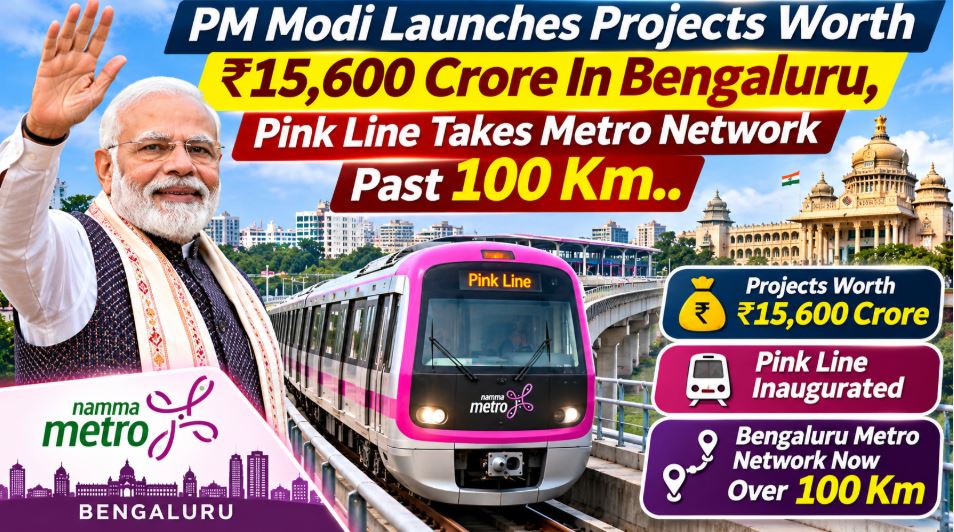
Bengaluru, Nov 13: Prime Minister Narendra Modi on Friday inaugurated and dedicated several development projects worth more than ₹15,600 crore to the nation in Bengaluru, Karnataka, while also laying foundation stones and flagging off new initiatives aimed at strengthening urban connectivity, railway infrastructure and energy security.
Representational Image
The projects span metro and railway connectivity, fuel storage and distribution, renewable energy and waste management. Addressing the gathering, Modi said robust infrastructure and improved connectivity were essential to creating employment opportunities, attracting industries and accelerating the country’s development.
He said the initiatives would strengthen Karnataka’s growth and contribute to the vision of a developed India, while reinforcing Bengaluru’s position as a major technology and innovation centre.
Bengaluru Metro Crosses 100-Km Milestone
Highlighting the inauguration of the Bengaluru Metro’s new Pink Line, the Prime Minister said the expansion would improve access to educational institutions, including IIM Bengaluru, as well as major business and commercial centres.
With its network now extending beyond 100 km, Bengaluru has become the third city in India, after the Delhi-NCR region and Mumbai Metropolitan Region, to cross the milestone.
Modi recalled that Namma Metro had a network of just 17 km in 2014. He said the expansion reflected the government’s focus on improving urban mobility and making daily travel more convenient and affordable for residents.
The Prime Minister also paid tribute to former Union Minister Ananth Kumar, recalling his close association with the region and his contribution to public life.
New Railway Links And Vande Bharat Service
Emphasising the transformation of Indian Railways, Modi said modern trains and upgraded stations were helping establish a distinct Indian identity in the country’s railway infrastructure.
He referred to the development of more than 60 Amrit Bharat stations in Karnataka, including those at Chamarajanagar, Chikkamagaluru, Sakleshpur and Subrahmanya Road. These stations are being equipped with improved facilities, including amenities for senior citizens and persons with disabilities.
The Prime Minister also noted that Karnataka’s railway budget allocation had increased ninefold over the past decade, while four Amrit stations and two railway doubling and electrification projects were among the initiatives highlighted during the event.
He flagged off a new Vande Bharat train connecting Karnataka and Goa, following the recent introduction of the state’s first Vande Bharat Sleeper train. The new service is expected to improve semi-high-speed rail connectivity along the coastal region, including Mangaluru.
Three Projects To Strengthen Energy Security
Underlining the importance of energy security amid geopolitical uncertainties in the Iran and Gulf region, Modi said investments made over the past decade had helped India strengthen its energy infrastructure and diversify supply sources.
He highlighted three projects in Karnataka:
Mangaluru LPG Project: Adds 80,000 metric tonnes of LPG storage capacity.
Devangonthi Marketing Terminal: Aims to improve the distribution of petrol, diesel and aviation fuel.
Bengaluru Compressed Biogas Plant: Will produce 13 tonnes of biogas daily, while supporting waste management and reducing dependence on imported natural gas.
The Prime Minister said reliable energy supplies would be crucial as India expands its ambitions in advanced technologies, including semiconductors, artificial intelligence, data centres and quantum computing.
He also pointed out that India’s renewable energy capacity had crossed 300 gigawatts.
Rooftop Solar Push For Households And Farmers
Modi highlighted the role of government schemes in encouraging households and farmers to become energy producers rather than remaining only electricity consumers.
Under the PM Surya Ghar Muft Bijli Yojana, more than 60 lakh households across the country have installed rooftop solar systems with government assistance. This includes over 40,000 households in Karnataka, with each eligible family receiving central assistance of around ₹80,000, he said.
He also referred to the installation of more than eight lakh solar pumps for farmers in Karnataka under the PM-KUSUM scheme. The initiative, he said, would help reduce irrigation-related electricity expenses and create opportunities for additional income.
Describing the shift, Modi said farmers were increasingly becoming ‘Urjadatas’ alongside their traditional role as ‘Annadatas’.
Middle Class And New Aspirational Economy
The Prime Minister said rising aspirations among India’s expanding middle class and Neo Middle Class were driving demand across sectors such as automobiles, electronics, tourism, education, healthcare and consumer services.
He said the government’s development approach was aimed at improving household savings and strengthening purchasing power.
Among the measures he cited were the exemption from income tax for annual income up to ₹12 lakh, changes in tax deduction at source rules benefiting senior citizens and people earning rental income, and next-generation GST reforms intended to reduce the cost of everyday goods.
He also referred to the removal of GST on personal health and life insurance, saying the move had made insurance more affordable.
Modi said the projects launched in Karnataka would support economic growth, improve public infrastructure and create new opportunities for citizens. He reiterated that the government’s priority was to increase middle-class savings and enable families to participate more actively in the country’s economic progress.