

In this story
New Delhi, Nov 26: India’s cheetah reintroduction programme has recorded a significant milestone, with the birth of nine cubs in two successive litters at Madhya Pradesh’s Kuno National Park, taking the country’s cheetah population to 62.
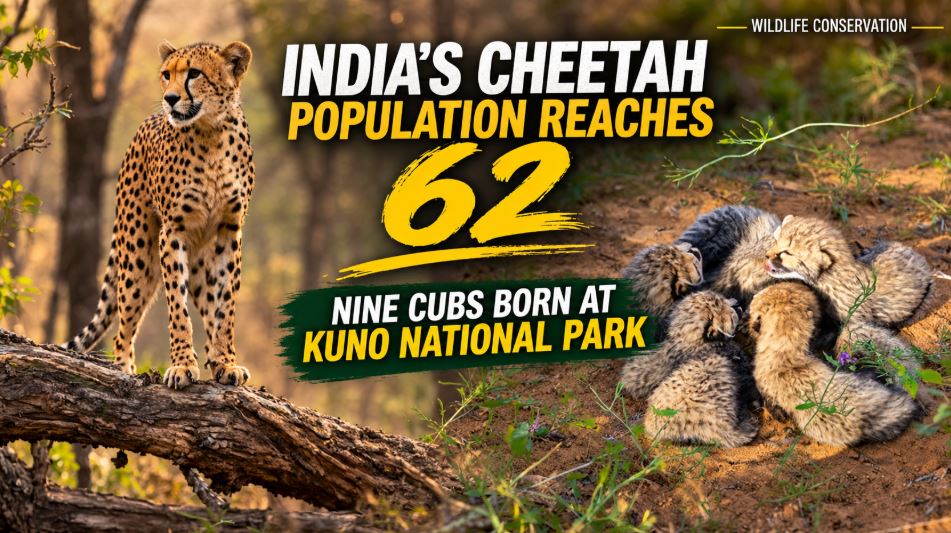
The births, recorded in October and November 2026, signal further progress in efforts to establish a breeding population of the species in India, which lost its native cheetahs more than seven decades ago.
According to the latest update under Project Cheetah, India-born animals now account for 43 of the 62 cheetahs, or nearly 70% of the total population. The growing share of locally born animals reflects the increasing contribution of natural reproduction to the programme.
Two litters mark important breeding milestones
The first litter was born on October 5, when KJP21, a 32-month-old female born in India, delivered five cubs. She is the third India-born female to reproduce under Project Cheetah, after Mukhi and KGP12.
The father of the cubs is a male brought from Botswana. The litter is therefore significant for introducing the Botswana genetic lineage into the India-born cheetah population.
The second litter arrived on November 20, when KOMG 3, a 30-month-old female translocated from Botswana, gave birth to four cubs. She became the first Botswana-origin female to give birth in India.
The birth took place in free-ranging conditions after the female had spent more than four months in the wild. It was also the second recorded instance of a cheetah giving birth outside a Closed Natural Area (CNA) since the reintroduction programme began in 2022.
These developments are important because the National Action Plan for Cheetah Introduction in India identifies successful breeding by India-born females and reproduction in free-ranging conditions as key indicators of progress.
However, the survival of the newborn cubs will remain crucial to determining the long-term success of the programme.
From extinction to an ambitious reintroduction effort
The cheetah was officially declared extinct in India in 1952. The last confirmed sighting of wild cheetahs was recorded in 1947 in the Sal forests of present-day Koriya district in Chhattisgarh. Hunting, poaching, habitat loss and declining prey populations contributed to the disappearance of the species.
India began its reintroduction effort on September 17, 2022, when eight cheetahs from Namibia were brought to Kuno National Park. Twelve more arrived from South Africa in February 2023, taking the initial founder population to 20.
The programme expanded further on February 28, 2026, with the arrival of nine cheetahs from Botswana—six females and three males. The addition of animals from different African populations is intended to broaden the genetic base and improve the long-term resilience of the reintroduced population.
Project Cheetah is implemented by the Ministry of Environment, Forest and Climate Change through the National Tiger Conservation Authority (NTCA), with scientific and field support from the Wildlife Institute of India and the Madhya Pradesh Forest Department.
Reproduction signals progress towards a resident population
A major objective of any wildlife reintroduction programme is to move beyond the survival of relocated animals towards a population capable of reproducing and sustaining itself in its new habitat.
The first major sign of this transition came in November 2025, when Mukhi became the first India-born female cheetah under the programme to give birth, producing five cubs. KGP12 and KJP21 subsequently reproduced, adding to the evidence that cheetahs born in India can reach maturity and breed locally.
The recent litters strengthen this trend. They also demonstrate the importance of maintaining genetic diversity through carefully planned introductions from different source populations.
Nevertheless, successful births alone do not establish a self-sustaining population. The National Action Plan identifies cub survival beyond one year as an important milestone, making continued monitoring and protection essential.
Science and habitat management underpin the programme
Kuno National Park, located in Sheopur district of Madhya Pradesh, was selected after assessments of habitat suitability, prey availability and human disturbance.
The preparation of the landscape included the relocation of 24 villages involving 1,545 families, making nearly 6,258 hectares available for wildlife conservation. Grassland restoration, prey augmentation and water management have also formed part of the habitat improvement measures.
The programme follows scientific principles informed by the International Union for Conservation of Nature guidelines on conservation translocations. Cheetahs are monitored through satellite radio collars, camera traps and field observations. Veterinary teams track their health, injuries, body condition and reproductive status, while prey surveys help assess the ecological conditions of the landscape.
Animals are initially kept in designated Closed Natural Areas before being moved into the wider landscape through a staged release process. This allows them to adapt gradually to local terrain, prey and climatic conditions.
Conservation linked with local livelihoods
Project Cheetah is also intended to support the conservation of grasslands and open forest ecosystems. Kuno’s prey base includes chital, sambar, nilgai, chinkara, chousingha and blackbuck. Chital is the most abundant wild prey and accounts for around three-quarters of recorded cheetah kills.
Local communities have also been involved in the conservation effort. More than 450 Cheetah Mitras serve as local ambassadors across 80 villages surrounding the park. The programme has generated around 380 direct jobs, including opportunities for trackers, patrol workers and trained guides.
Villages around Kuno receive a five per cent share of eco-tourism revenue, while development initiatives covering roads, check dams and sanitation have extended across more than 100 villages.
The involvement of local residents is considered important for building long-term support for wildlife protection and ensuring that conservation benefits reach communities living around the protected landscape.
Expanding beyond Kuno
The programme’s long-term goal is to establish a self-sustaining metapopulation of 60 to 70 cheetahs by 2032 across an estimated 17,000 square kilometres in the Kuno-Gandhi Sagar landscape.
Gandhi Sagar Wildlife Sanctuary in Madhya Pradesh has been developed as the second site. Two cheetahs, Prabash and Paavak, were shifted there from Kuno in April 2025, followed by the relocation of two females.
The programme expanded to another habitat in October 2026, when two cheetahs from Kuno were released into Veerangana Durgavati Tiger Reserve in Sagar district, making it the third cheetah habitat in Madhya Pradesh.
The country’s population of 62 cheetahs has now reached the lower end of the programme’s targeted range. But the presence of newborn cubs means the total must be viewed alongside their survival prospects and future breeding potential.
The latest births offer fresh encouragement for India’s ambitious conservation effort. Whether the programme ultimately succeeds will depend not only on increasing numbers, but also on establishing healthy breeding populations across suitable habitats and ensuring that the species can survive independently in the wild.