Mandi, Sep 21: The School of Management, Indian Institute of Technology Mandi, concluded AiXcelrate 4.0, the fourth edition of its flagship AI and leadership conclave, bringing together industry leaders, domain experts, practitioners, faculty members and students for two days of discussions on the changing relationship between artificial intelligence, leadership and business value.
Held on 19–20 September 2026 at the IIT Mandi campus, the conclave was organised around the theme “Next Gen AI-Leadership: Beyond the Horizon to Monetizing AI.” The programme examined three interconnected transitions in contemporary AI adoption: moving from productivity and automation to strategic advantage, converting AI adoption into accelerated growth, and taking AI initiatives from pilot projects to sustainable and profitable scale.
Reflecting on the larger significance of these developments, Prof. Laxmidhar Behera, Director, IIT Mandi, emphasised the need to place responsibility and societal impact at the centre of AI leadership.
“As artificial intelligence becomes increasingly embedded in organisations and society, leadership cannot be defined only by how quickly we adopt new technologies. Responsible AI leadership requires us to consider the larger societal consequences of the choices we make, while ensuring that innovation remains aligned with human values and meaningful outcomes. Institutions such as IIT Mandi have an important role in preparing leaders who can combine technological capability with responsibility and social purpose.”
From Automation to Strategic Advantage
The first day featured the panel “Moving from Productivity and Automation to Strategic Advantage: The AI Value Shift,” which examined whether gains in efficiency and automation are sufficient to produce sustainable competitive advantage and how organisations can move towards more strategic applications of AI.
During the discussion, Ashley D’Acouza, Chief Data Officer, Hindustan Coca-Cola, cautioned against assuming that widespread access to AI automatically translates into competitive advantage.
“The AI advantage is still far away. We are still in the experimentation phase,” he said, emphasising that outcomes depend significantly on leadership, strategic vision and the ability of organisations to connect available technologies with their specific business requirements. He also underlined that technological capabilities are currently developing faster than their widespread application within industry.
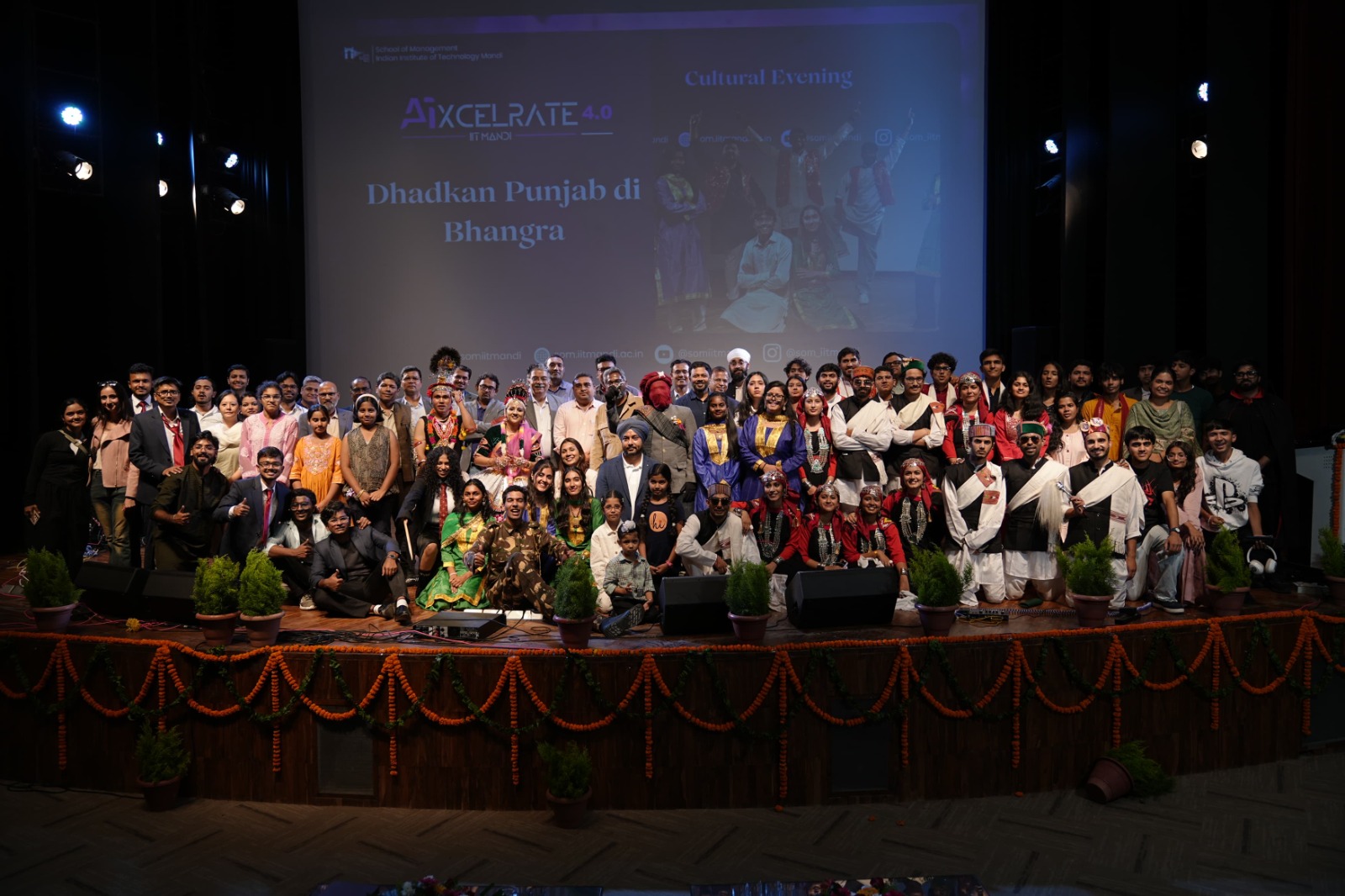
The first day also included mentoring sessions and an industry-academia brainstorming session, creating opportunities for students to interact directly with practitioners and engage with emerging managerial challenges. Day 1concluded with HimTarang – Cultural Evening, which brought together members of the IIT Mandi community through a range of cultural and creative performances, adding a celebratory dimension to the conclave.
From Adoption to Growth and from Pilot to Profit
The second day extended the discussion through two panels addressing the next stages of organisational AI maturity.
The panel “Moving from AI Adoption to AI Advantage: Accelerating Growth” focused on how organisations can connect growing AI adoption with tangible business outcomes including customer acquisition, personalisation, innovation, improved decision-making and revenue growth. The discussion also highlighted the importance of identifying credible measures that can distinguish technological experimentation from demonstrable business value.
During the second panel, Rohit Kilam, Chief Technology Officer at HDFC Life, reflected on the changing division of labour between humans and artificial intelligence, arguing that AI is likely to take over much of what is readily verifiable, while areas characterised by ambiguity and unverifiability will continue to require human judgement.
“The verifiable will increasingly be taken over by AI, but the unverifiable will remain. That is where humans will continue to stay relevant,” he said, emphasising that organisations should focus on strengthening the distinctly human capacities for judgement, interpretation and decision-making that AI cannot simply automate.
The subsequent panel, “Moving from Pilot to Profit: Scaling AI,” turned attention to the challenges of taking promising AI experiments to enterprise-wide implementation. Discussions addressed data infrastructure, integration with existing systems, governance, workforce readiness, cost, human oversight and the need to assess which AI initiatives are capable of delivering sustainable returns at scale.
Industry Challenge Brings AI Thinking into the Classroom
A significant component of AiXcelrate 4.0 was the Industry Case Competition, sponsored and powered by 6D Technologies, which gave MBA and Integrated MBA students an opportunity to work on an industry-oriented business challenge. Teams were required to analyse the problem, develop recommendations and present their proposed solutions before a jury, combining strategic thinking, analytical reasoning and innovation.
The competition was designed around teams of four to five students working on a common industry challenge and defending their recommendations before a jury that included industry representatives.
Team Tactical Minds emerged as the winner of the AiXcelrate 4.0 Industry Case Competition, while The Case Solvers and The InsightX secured the first and second runner-up positions, respectively.
Commenting on the event, Prof. Anjan K. Swain, Chairperson, School of Management, IIT Mandi, highlighted the importance of what he described as the three S’s: scope, speed and scale in understanding the emerging relationship between AI and business.
“The business implications of AI increasingly need to be understood through three dimensions: scope, speed and scale. Its scope is expanding across organisational functions, the speed of technological change is accelerating, and organisations are confronting the challenge of scaling AI in ways that create genuine business value. AiXcelrate provides a platform to examine these questions by bringing management education into direct conversation with industry practice.”
The conclave also featured student presentations and mentoring interactions before concluding with the valedictory session. The programme was designed to enable sustained exchange between industry experience and management education rather than treating AI simply as a technological subject. The event schedule brought together panel discussions, mentoring, student engagement and industry-academia interaction across the two days.
Delivering the vote of thanks, Dr. Ashish Bollimbala, Faculty Coordinator, AiXcelrate 4.0, thanked the industry speakers and panellists, participating organisations, 6D Technologies, students, faculty colleagues and members of the organising team for their contribution to the conclave. He acknowledged the collective effort involved in bringing industry and academia together around questions that are increasingly central to the future of management and leadership.
With its emphasis on strategic value, responsible leadership and the organisational realities of scaling AI, AiXcelrate 4.0 concluded by underscoring that the next phase of artificial intelligence will be shaped not simply by technological capability, but by the quality of the managerial and leadership decisions surrounding its adoption and use.