

In this story
Artificial Intelligence (AI) has become an important part of modern education. From ChatGPT and Google Gemini to AI-powered writing assistants and problem-solving applications, students today have access to tools that can provide instant answers to almost every academic question. These technologies have made learning faster, easier, and more convenient.
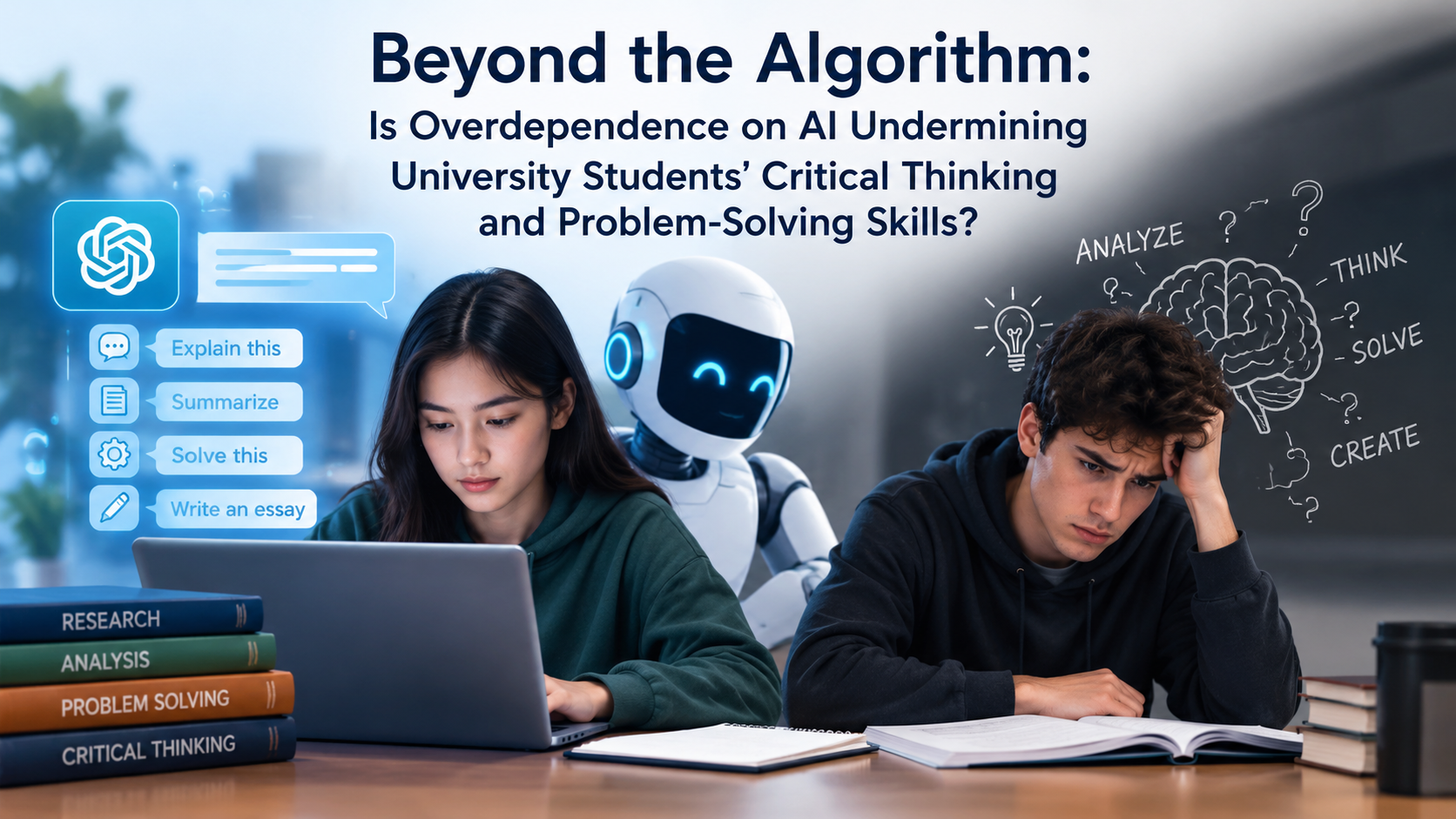
University education is not simply about obtaining information or completing assignments. It is about developing critical thinking, creativity, independent reasoning, decision-making, and the ability to solve complex problems. While AI can support these learning objectives, excessive dependence on it may prevent students from developing these essential skills.
The Growing Dependence on AI Tools Among University Students
In recent years, AI tools have become increasingly popular among university students. Students use them to prepare assignments, write essays, summarize lengthy chapters, solve mathematical problems, generate presentations, and even prepare for examinations.
Instead of spending hours researching a topic or trying to understand a difficult concept, students can now receive an answer within seconds. For example, a student struggling with a programming question may simply copy the problem into an AI chatbot and obtain the solution without understanding the underlying logic.
Similarly, students may use AI to write entire assignments rather than developing their own arguments and ideas. Although this approach saves time and effort, it can gradually create a habit of depending on technology instead of thinking independently.
The convenience of AI is undeniable, but the real question is whether students are using it as a learning assistant or allowing it to replace their own thinking.
How Overdependence on AI Can Affect Problem-Solving Abilities
Problem-solving is one of the most important skills students develop during their university years. It involves identifying problems, analysing information, exploring possible solutions, and making logical decisions. Excessive reliance on AI may negatively affect this process in several ways.
1. Decline in Critical Thinking Skills
Critical thinking requires students to question information, evaluate evidence, identify errors, and develop independent opinions. When students accept AI-generated answers without questioning their accuracy, they may lose opportunities to practise these abilities.
Rather than analysing a topic from different perspectives, they may simply accept the first answer provided by an AI tool. Over time, this can reduce their ability to think critically and make informed decisions.
2. Reduced Creativity and Original Thinking
Creativity develops when students explore new ideas, experiment with different approaches, and learn from mistakes. However, depending too heavily on AI-generated content may limit these experiences.
For instance, when students use AI to generate project ideas, write stories, or prepare presentations, they may become less motivated to develop original thoughts. As a result, their work may become more repetitive and less innovative.
3. Weakening of Independent Learning Habits
University students are expected to take responsibility for their own learning. They should be able to research unfamiliar topics, understand difficult concepts, and find solutions independently.
However, instant AI-generated answers can make students impatient with the learning process. Instead of reading textbooks, consulting research papers, or discussing problems with classmates, they may prefer asking AI for immediate solutions.
This habit can weaken their confidence in handling academic challenges without technological assistance.
4. Lack of Deep Understanding
Getting the correct answer does not necessarily mean understanding the concept behind it. AI tools can provide solutions to complicated questions, but students may fail to understand the reasoning behind those answers.
For example, a computer science student may use AI to generate a complete programming code. Although the code may work, the student might struggle to explain its logic or modify it when faced with a different problem.
This creates a gap between completing academic tasks and actually acquiring knowledge.
The Positive Side of AI in Education
Despite these concerns, it would be unfair to consider AI entirely harmful to education. When used responsibly, AI can become a powerful learning partner.
AI tools can explain difficult concepts in simple language, provide personalised learning experiences, identify mistakes, and offer additional practice questions. They can also help students overcome learning difficulties by presenting information in different formats.
For example, a student learning mathematics can use AI to understand a complicated formula through step-by-step explanations. Similarly, a programming student can use AI to identify errors in code and understand why those errors occurred.
AI also saves time by helping students organise information, generate study plans, and explore unfamiliar subjects.
Therefore, the problem is not the existence of AI tools but the way students use them. AI should strengthen human intelligence rather than replace it.
The Role of Universities and Teachers
Universities and educators have an important responsibility to ensure that students use AI effectively without compromising their intellectual development.
First, universities should introduce AI literacy programmes that teach students how to use AI tools responsibly and ethically. Students should understand that AI-generated information may contain errors and must be verified using reliable sources.
Second, teachers should encourage assignments that require original analysis, practical application, research, and personal reflection rather than tasks that can easily be completed by copying AI-generated answers.
Third, universities should focus more on practical learning activities, group discussions, debates, case studies, laboratory experiments, and project-based learning. These activities encourage students to think independently and develop real-world problem-solving skills.
Finally, students should be evaluated not only on their final answers but also on their ability to explain the reasoning and process behind those answers.
How Students Can Maintain a Balance Between AI and Independent Thinking
Students do not need to stop using AI tools. Instead, they should develop healthy habits that allow them to benefit from technology while maintaining their intellectual abilities.
Some effective practices include:
-
Think before asking AI: Try solving a problem independently before seeking assistance.
-
Understand instead of copying: Read AI-generated answers carefully and understand the logic behind them.
-
Verify information: Cross-check important facts with textbooks, academic journals, and reliable sources.
-
Practise independent problem-solving: Regularly solve problems without depending on digital assistance.
-
Use AI as a tutor: Ask AI to explain concepts, provide hints, and identify mistakes rather than simply giving final answers.
-
Develop original ideas: Make an effort to create personal arguments, solutions, and perspectives.
By following these practices, students can use AI as a supportive educational resource while continuing to develop their own abilities.
Conclusion
Artificial Intelligence is transforming the educational landscape, offering university students opportunities to learn more efficiently and access information more easily than ever before. However, its growing influence also presents a serious challenge. Excessive dependence on AI tools may weaken critical thinking, creativity, independent learning, and problem-solving abilities if students allow technology to do all the intellectual work for them.
The purpose of education is not merely to find the correct answer but to understand how and why that answer is reached. Students must remember that technology can provide information, suggest solutions, and simplify complex tasks, but it cannot replace the value of personal experience, curiosity, and independent reasoning.