

In this story
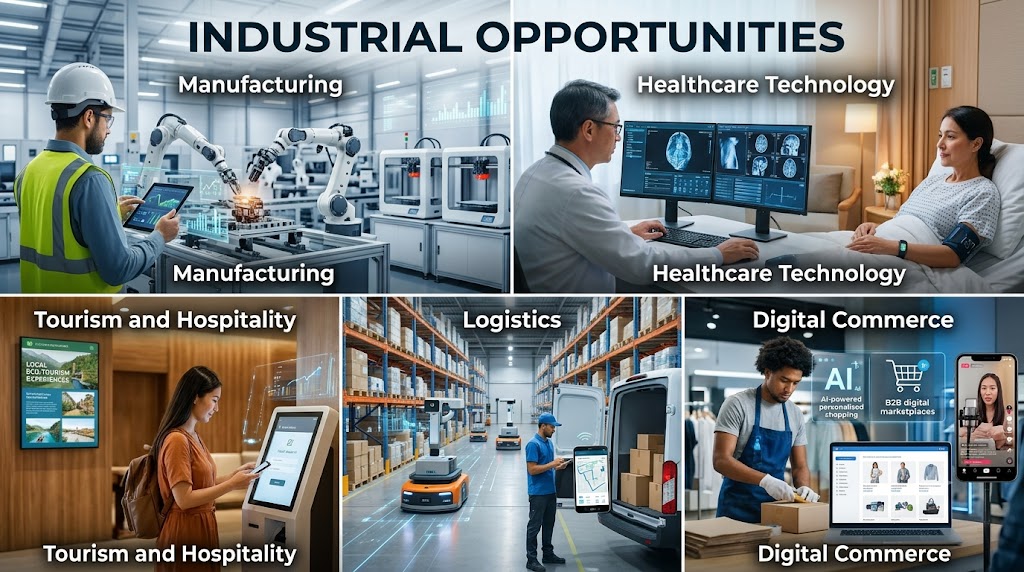
Industry-specific opportunities are expanding as businesses adapt to new technologies, changing customer expectations and rising pressure to improve efficiency. From smart factories and digital healthcare to automated warehouses and personalised shopping, companies are finding new ways to reduce costs, improve services and reach more customers.
The shift is creating opportunities for established businesses as well as startups offering practical solutions to everyday industry challenges. Rather than relying only on traditional expansion, companies are increasingly investing in automation, data-driven decision-making and digital services to remain competitive.
Manufacturing, healthcare technology, logistics, tourism and digital commerce stand out because each sector faces distinct challenges that technology can help address. Businesses that understand these needs and develop solutions suited to their markets could find opportunities for sustainable growth.
Manufacturing: Smarter Factories and Efficient Production
Manufacturing businesses are increasingly adopting technology to improve productivity, reduce downtime and respond more quickly to customer demand. Flexible production systems allow factories to adjust operations without making major changes to their physical infrastructure.
Industrial Internet of Things (IIoT) sensors can monitor machinery and identify signs of potential failure before equipment breaks down. This helps manufacturers plan maintenance, reduce production interruptions and make better use of expensive assets.
Three-dimensional (3D) printing is also creating opportunities beyond product design and prototyping. Businesses can use it to produce specialised components, customised parts and selected end-use products, particularly where traditional manufacturing methods may be expensive or inflexible.
Another growing opportunity lies in energy-efficient manufacturing. Companies that monitor energy consumption, reduce material waste and improve resource management can strengthen their environmental performance while controlling operating costs.
For small and medium-sized manufacturers, affordable automation and predictive maintenance services offer a practical way to improve efficiency without completely rebuilding existing production facilities.
Healthcare Technology: Making Care More Accessible
Healthcare technology is creating opportunities to improve patient care while helping hospitals and medical professionals manage growing workloads. Digital solutions are increasingly supporting diagnosis, patient monitoring and routine administrative tasks.
AI-assisted diagnostic tools can help medical professionals identify potential abnormalities in medical images, while digital assistants can reduce the time spent preparing clinical notes. These technologies can improve workflows, although medical decisions must remain subject to appropriate professional oversight.
Remote patient monitoring is another important area. Wearable devices and connected medical equipment can track selected health indicators and help clinicians monitor patients outside traditional hospital settings. Such solutions may be particularly useful for managing chronic conditions and supporting follow-up care.
Healthcare cybersecurity also presents a growing business opportunity. As hospitals and clinics rely on connected devices and digital patient records, protecting sensitive information and maintaining reliable systems become increasingly important.
Startups and established technology providers can find opportunities in secure software, remote monitoring platforms and tools that make healthcare services more efficient. The strongest solutions will combine practical benefits with patient privacy, reliability and ease of use.
Logistics: Technology Improves the Movement of Goods
The expansion of e-commerce and increasingly complex supply chains is creating demand for faster, more reliable logistics services. Businesses must manage delivery expectations while controlling fuel costs, labour expenses and warehouse operations.
Automation is helping address these challenges. Autonomous mobile robots and automated storage systems can support warehouse workers with picking, sorting and moving goods. For logistics companies handling large order volumes, these systems can improve speed and operational consistency.
Route optimisation software offers another opportunity by analysing traffic, weather and delivery schedules to identify more efficient routes. Real-time tracking platforms can also give businesses better visibility into shipment locations and delivery conditions, particularly for temperature-sensitive products such as food and medicines.
Electric delivery vehicles and other lower-emission transport options are creating additional opportunities as businesses seek to manage fuel expenses and environmental impact.
For smaller logistics operators, digital tracking, route-planning software and warehouse management tools can deliver meaningful improvements without requiring large-scale automation from the outset.
Tourism and Hospitality: Personalised Travel Experiences
Tourism businesses are responding to travellers who increasingly value convenience, distinctive experiences and services suited to their individual preferences. Technology is helping hotels, travel companies and local tourism operators meet these expectations.
AI-powered booking platforms can recommend accommodation, activities and travel plans based on customer interests and budgets. Hotels are also adopting digital check-ins, mobile room keys and smart energy controls to improve convenience and manage operating costs.
Sustainable tourism presents another business opportunity. Travellers and corporate customers may seek accommodation and experiences that demonstrate responsible resource use and support local communities. Businesses that communicate their sustainability practices clearly can appeal to these preferences while creating opportunities for local suppliers and service providers.
Smaller hotels, regional tour operators and community-based tourism businesses can benefit from online booking platforms and digital marketing that help them reach customers beyond their immediate markets.
The commercial opportunity lies in using technology to improve the travel experience without losing the personal service and local character that make destinations attractive.
Digital Commerce: More Personalised Shopping and Better Reach
Digital commerce continues to change how consumers discover products and how businesses sell them. Retailers are looking beyond conventional online storefronts to create more personalised and convenient shopping experiences.
AI-powered shopping assistants and visual search tools can help customers find products based on their needs, questions or images. Social and video commerce also allow businesses to connect product discovery with purchasing, reducing the steps between seeing an item and buying it.
Business-to-business (B2B) e-commerce is another promising area. Digital marketplaces can simplify wholesale purchasing for retailers, restaurants, construction businesses and other organisations that traditionally depend on manual ordering processes.
Flexible commerce technology also allows retailers to update their websites, payment options and customer experiences more quickly as market conditions change.
For small businesses, online marketplaces and social commerce offer opportunities to reach wider audiences without the cost of building a large physical retail network. However, success still depends on customer trust, reliable delivery, transparent pricing and effective after-sales service.
What These Opportunities Mean for Businesses
Across all five sectors, technology is creating opportunities to solve specific business problems rather than simply digitise existing processes. Manufacturers want fewer production delays, healthcare providers need more efficient workflows, logistics companies seek better delivery performance, tourism operators aim to improve customer experiences, and retailers want to convert customer interest into sales.
This creates room for specialised technology providers, service companies and startups that understand the practical needs of individual industries. Businesses that begin with clearly defined problems and measurable outcomes may be better positioned to justify investment and demonstrate value.
However, technology adoption also requires careful planning. Implementation costs, employee training, cybersecurity, data quality and customer acceptance can affect results. Companies need to choose solutions that fit their size, operational capacity and long-term goals.
Conclusion
Industry-specific opportunities in manufacturing, healthcare technology, logistics, tourism and digital commerce are growing as businesses look for more efficient and customer-focused ways to operate. Automation, artificial intelligence and digital platforms are creating new possibilities, but their value depends on how effectively they address real market needs.
For startups, the opportunity lies in developing focused solutions that solve problems within a particular industry. For established companies, investing in the right technology can strengthen competitiveness, improve service quality and support expansion into new markets.
Ultimately, businesses that combine innovation with practical execution, skilled employees and a clear understanding of their customers will be better placed to turn these emerging opportunities into long-term growth.