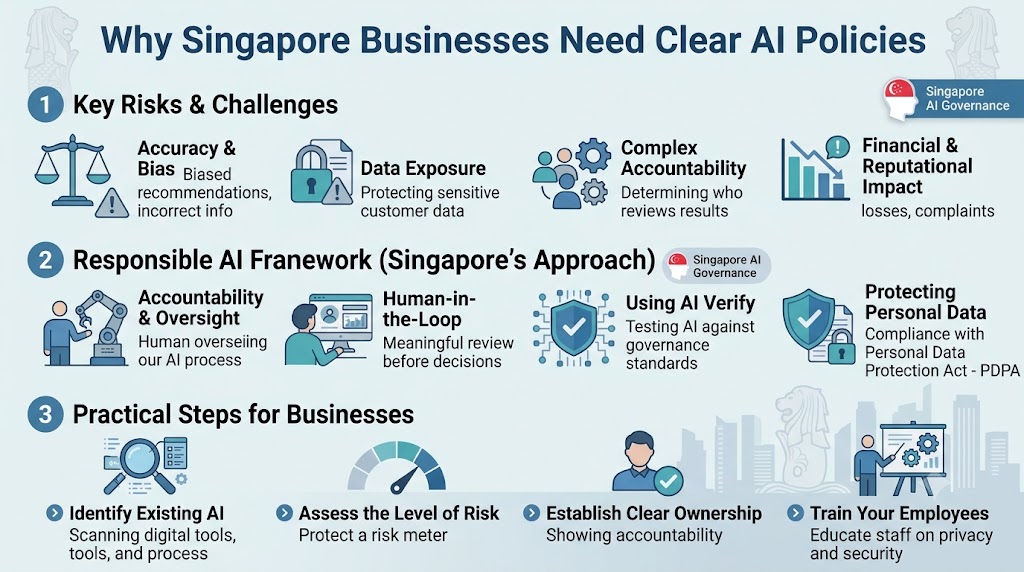
Artificial intelligence is changing the way businesses operate in Singapore. Companies are using AI to improve customer service, analyse business data, automate routine tasks and make faster decisions. While these technologies offer significant opportunities, they also raise important questions about data protection, accountability and the reliability of automated decisions.
For businesses, adopting AI is no longer simply a matter of choosing the right software. They must also understand how these systems work, where they can make mistakes and what safeguards are needed to protect customers and business operations.
This has made AI governance in Singapore an increasingly important business consideration. A well-planned approach can help companies manage emerging risks without losing the efficiency and competitive advantages that AI offers.
Singapore has taken steps to encourage responsible AI adoption through governance guidelines, testing tools and industry initiatives. As businesses explore more advanced systems, including AI agents capable of carrying out tasks with limited human intervention, the need for clear rules and effective oversight is becoming even more important.
Why Businesses Need Clear AI Policies
AI can help businesses reduce repetitive work, improve productivity and respond to customers more efficiently. However, these benefits can be undermined when systems are introduced without proper planning.
An AI tool may generate inaccurate information, produce biased recommendations or expose confidential data if employees use it carelessly. Automated decisions can also be difficult to explain, particularly when businesses rely on complex systems to assess applications, recommend products or evaluate customer information.
Such problems can affect more than day-to-day operations. They may lead to financial losses, customer complaints, damaged reputations and additional compliance costs.
Clear AI policies help businesses establish how the technology should be used, which applications require approval and who is responsible for reviewing the results. They also give employees practical guidance on handling sensitive information and checking AI-generated content before it reaches customers.
For smaller businesses, these basic measures can provide valuable protection without requiring a large compliance team or a costly technology programme.
Singapore’s Approach to Responsible AI
Singapore has focused on helping businesses adopt AI while encouraging responsible development and use. Its approach provides practical guidance that organisations can adapt according to their operations, technology and level of risk.
The country’s Model AI Governance Framework outlines important considerations such as accountability, human involvement, transparency and the management of AI-related risks. AI Verify also offers tools to help organisations evaluate AI systems against selected governance principles.
These initiatives can help businesses move beyond general commitments to responsible AI and examine how their systems perform in practice.
However, using a governance framework or testing tool does not automatically make an AI application safe or compliant. Businesses still need to assess the specific risks associated with each application, understand their legal responsibilities and review systems as circumstances change.
The most effective approach is to make AI oversight part of normal business management, with responsibilities shared across technology teams, management and employees who use the tools.
Protecting Data and Maintaining Customer Trust
Data is at the heart of many AI applications. Businesses use information to personalise services, understand customer behaviour, improve marketing and support operational decisions. But when sensitive information is entered into AI platforms without adequate safeguards, the risks can be substantial.
Companies should understand what data their AI tools collect, how it is processed, where it is stored and whether it may be shared with external providers. Customer records, employee information, financial details and confidential business documents require particular care.
Singapore’s Personal Data Protection Act remains relevant to organisations handling personal data within its scope. Businesses should review their data practices, assess the privacy implications of new AI applications and ensure employees know which information can safely be shared with digital tools.
Third-party providers also require careful consideration. Before adopting an AI service, companies should examine its data-handling arrangements, access controls, security measures and contractual terms.
Strong data protection practices can help prevent avoidable incidents while reinforcing customer confidence. In competitive markets, customers are more likely to maintain relationships with businesses that demonstrate care in handling their information.
Generative AI and the Rise of AI Agents
Generative AI has made it easier for employees to draft content, summarise documents, analyse information and assist with customer enquiries. Yet these tools can sometimes produce incorrect answers or present uncertain information with unwarranted confidence. Human review remains essential when the output could affect business decisions or customer interests.
A newer development is agentic AI, which can plan tasks and take actions across digital systems rather than simply respond to a prompt. Depending on how it is configured, an AI agent may interact with business applications, retrieve information or carry out a sequence of tasks with limited human involvement.
This creates additional governance challenges. An error made by a content-generation tool may require a correction, while an improperly controlled agent could alter records, disclose information or initiate an unauthorised action.
Singapore’s governance efforts have increasingly addressed these emerging risks, including through guidance specifically designed for agentic AI.
Businesses should establish clear limits on what AI agents can access and do. Actions involving money, sensitive records, legal commitments or significant customer consequences may require explicit human approval. Companies should also maintain records of important actions, monitor system behaviour and establish procedures for investigating errors.
As AI systems become more capable, effective oversight must extend beyond the quality of their responses to the actions they are permitted to take.
Practical Steps for Businesses Adopting AI
Responsible AI adoption does not have to begin with complicated procedures. Businesses can start with a few practical measures and strengthen them as their use of the technology expands.
Identify existing AI use. Companies should understand which tools employees and departments are using, including applications introduced without formal approval.
Assess the level of risk. An AI tool used for routine administrative work may require fewer controls than one involved in recruitment, financial assessments or sensitive customer information.
Establish clear accountability. Employees should know who approves AI applications, who monitors their performance and who handles problems. Responsibility should not disappear simply because an external provider supplies the technology.
Keep human oversight meaningful. Important AI-generated recommendations should be reviewed by people who understand the subject and can question the results. Human involvement should be more than a routine approval step.
Train employees. Staff need practical guidance on data privacy, accuracy checks, security risks and the appropriate use of AI-generated material.
Review performance regularly. Businesses should monitor results, investigate unexpected behaviour and reassess systems when software, data or business requirements change.
These steps can help organisations introduce AI in a controlled manner while allowing employees to benefit from automation and improved access to information.
Making AI Governance Part of Business Growth
For businesses in Singapore, responsible AI governance can support more than risk reduction. It can help management make better technology investments, improve internal processes and demonstrate reliability to customers and business partners.
Companies that understand the limitations of their AI systems are better placed to identify where automation delivers genuine value. They can also avoid spending money on applications that introduce unnecessary complexity or require more supervision than expected.
Small and medium-sized enterprises can benefit from a proportionate approach that focuses resources on the most important risks. Simple approval procedures, clear data-handling rules and regular employee training can provide a useful starting point.
As competition increases, the ability to use AI effectively and responsibly may become an important differentiator. Businesses that combine technological innovation with sound judgement can improve productivity while protecting the relationships on which their growth depends.
Conclusion
Artificial intelligence is opening new opportunities for Singapore businesses, from faster customer service to more efficient operations and data-driven decision-making. However, its long-term value will depend on how carefully organisations manage the risks that accompany its adoption.
Clear policies, responsible data handling, appropriate human oversight and regular system reviews can help businesses use AI with greater confidence. These practices are particularly important as technology moves beyond generating information towards making decisions and carrying out tasks.
AI governance should not be viewed as an obstacle to innovation, but as a foundation for sustainable business growth. Companies that make accountability and customer trust part of their AI strategy will be better prepared to embrace new technologies while protecting their operations, reputation and long-term commercial interests.