

In this story
Bhubaneswar, Nov 11 (UDN): In a significant development in advanced materials research, a scientist from the Indian Institute of Technology (IIT) Bhubaneswar has identified a promising material that could help electronic devices retain information for longer periods while improving energy efficiency.
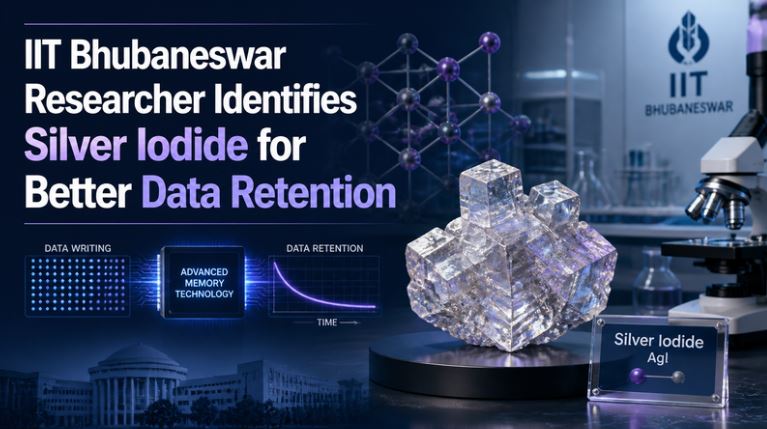
Representational Image
The research focuses on silver iodide (AgI), a semiconductor material that could open new possibilities for developing next-generation electronic devices based on spintronics, an emerging technology designed to make data storage and processing more efficient.
The study, led by Manish Kumar Mohanta, Ramanujan Faculty in the Department of Physics at IIT Bhubaneswar, identifies a particular surface of silver iodide as a potential candidate for stable spin-based electronic applications.
The findings have been published in the prestigious journal Physical Review B, published by the American Physical Society.
What Makes the IIT Bhubaneswar Discovery Important?
Unlike conventional electronics, which primarily rely on the electrical charge of electrons to process information, spintronics uses an additional property known as electron spin.
This technology has attracted considerable research interest because it could enable faster, more energy-efficient electronic devices with improved data storage capabilities.
However, one of the major challenges in developing spintronic devices is maintaining the orientation of electron spins over time. When this alignment gradually disappears, it can affect the reliability of information stored in the system.
The IIT Bhubaneswar research explores a phenomenon called Persistent Spin Texture (PST), which allows electron spins to maintain a stable and organised alignment for longer periods.
This property is considered important for developing more reliable spin-based electronic technologies.
Silver Iodide Shows Promising Spin Stability
According to the study, computer simulations indicate that the (110) surface of silver iodide can support a stable spin arrangement, even when subjected to moderate mechanical strain.
This suggests that the material could retain its desirable spin properties under certain physical conditions, making it a promising candidate for future spintronic applications.
The researchers also examined how external electric fields influence this spin arrangement.
Their simulations showed that applying an electric field perpendicular to the surface can disturb the spin pattern, indicating that the electronic properties of the material may be controlled through electrical inputs.
This feature could be particularly useful in designing devices where electron spin states need to be manipulated for information processing and storage.
Research Could Benefit Future Computing Technologies
The findings could have important implications for the development of next-generation electronic and computing devices.
Materials capable of maintaining stable electron spin configurations could help address some of the limitations associated with conventional data storage technologies.
The research may eventually contribute to spintronic systems offering improved data retention, lower energy consumption and more efficient information processing.
Although further research and experimental validation will be necessary before the material can be translated into commercial devices, the findings represent a promising step in the exploration of advanced materials for future electronics.
The study also highlights IIT Bhubaneswar’s contribution to cutting-edge research in semiconductor physics and emerging computing technologies.