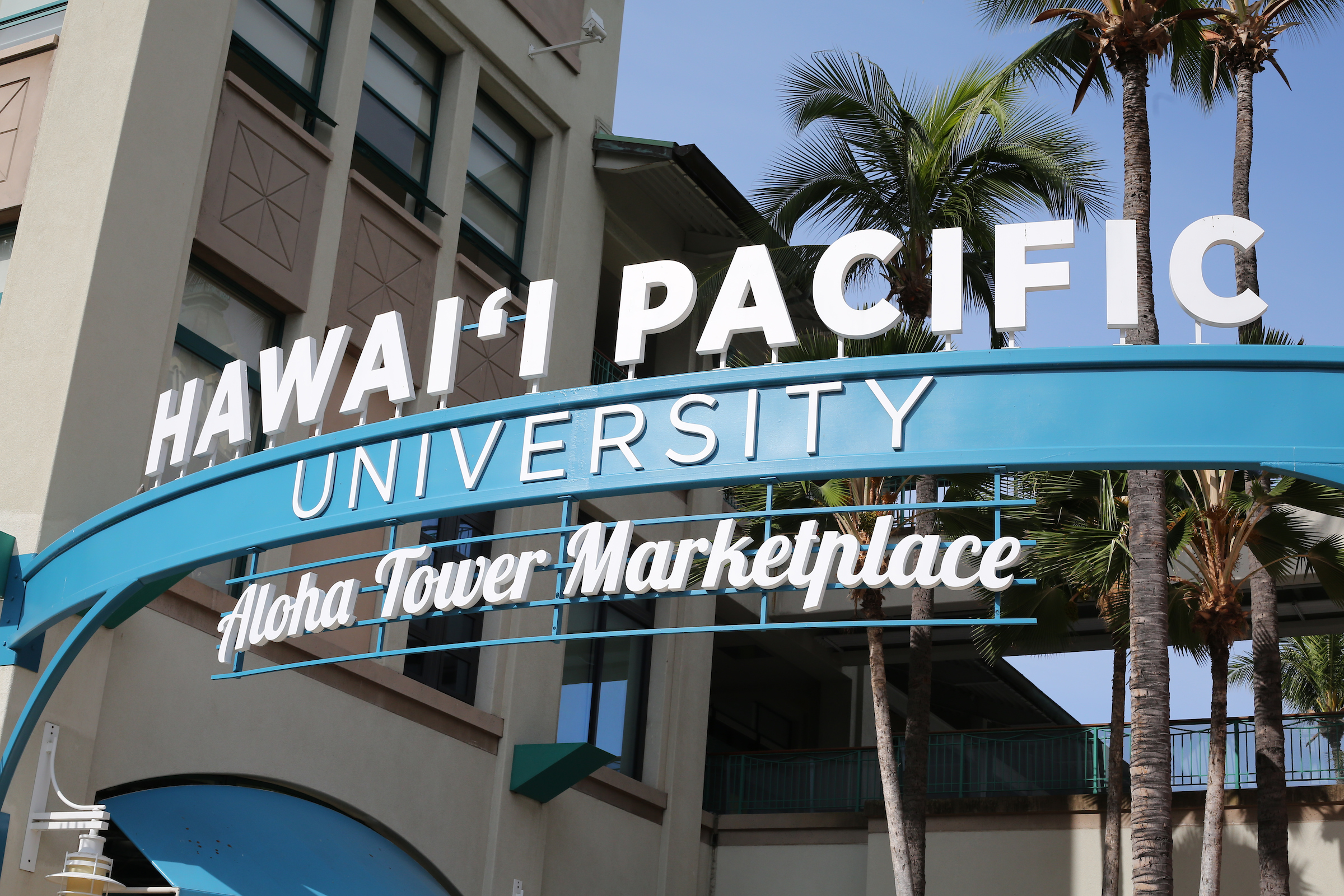
HONOLULU | Aug 12: Nearly 60 Hawaiʻi high schoolers walked into HPU’s Sunset Ballroom at Aloha Tower Marketplace on July 27 with an idea and a laptop. By Friday afternoon, they had honed their “why,” their target market, and solution, walking out with a nascent venture and live websites they had built themselves.
The free HPU x Blue Startups Entrepreneurship Bootcamp, held July 27 to 31 and sponsored by HPU’s John F. Scarpa Entrepreneurial Pathway, brought together rising juniors and seniors from 18 public and private schools across the islands for five days of building. Working solo or in groups of two or three, students launched 40 ventures, each one identifying a business opportunity, designing a brand, building and publishing a live website (with AI tools), producing marketing assets and presenting the result to a panel of founders, mentors, and investors.
“What we saw this week is exactly why the Scarpa Entrepreneurial Pathway exists at HPU,” said HPU College of Business Dean Amy Nguyen-Chyung, Ph.D., lead of the Pathway. “At the start of the week, the students formed an initial idea of their business opportunity and by Friday, they had built real websites identifying the problem and solutions and stood up in front of founders and investors to defend their work. This group went further by envisioning their target customer’s key characteristics with an empathy map and turning those target customers into a virtual business advisor using AI. I am so impressed by their work and presentation skills. Investing in developing youth entrepreneurship and leadership skills is a worthwhile way in which HPU and the Scarpa Pathway can engage with the community.”
The Bootcamp was led by Alexi Drouin, an entrepreneur, HPU adjunct professor and academic director at Blue Startups, Hawaiʻi’s premier tech accelerator and a program ranked among the top 20 in the country by TechCrunch.
Each day carried a theme and ended with something shipped. Monday was Find Your Opportunity, when students landed on an idea and drafted a name, a logo and a one-liner. Tuesday was Design Your Solution, when they pressure-tested those ideas against AI-simulated customers and toured HPU’s waterfront campus and Makerspace. Wednesday was Build Your Website, a full day of production that ended with every student holding a public URL. Thursday was Launch Your Idea, devoted to social posts, short videos and slide decks. Friday was Present Your Business.
Guest speakers came from across the local startup community and, in one case, from the students’ own generation. Coen Cadinha of Keiki Rise and Big Boy Sweets opened the week as a peer-age founder.
Nalukai Foundation Board President Allen Murabayashi presented on Tuesday about the importance of talking to customers. Giovanna (“Gigi”) Scholbi (HPU ’25) of Cheeki Swimwear spoke about writing down goals and going after them while also giving tips about sourcing sustainable materials.
Miki Hardisty of Olelo Intelligence spoke Wednesday about building an AI company in Hawaiʻi and led the students in an exercise of using agentic AI.
ʻIolani School’s Gabriel Yanagihara spoke Thursday to talk about AI in the classroom and online. On multiple days, Nguyen-Chyung introduced additional examples to drive home the importance of problem identification, product market fit and writing down key components of the one’s plan using a simple canvas.
On Friday, presentation day filled the room with students, parents, teachers and HPU staff. HPU entrepreneurial coordinator and small business management instructor Richard Kebo listed the three key requirements needed before making a sale (business registration, bank account and general excise tax number). Individuals and teams took the front of the room in turn, speaking for 60 seconds, showcasing their business websites and presenting the overarching goals of their companies. After every four presentations, the expert panel offered feedback to the groups.
The panel included Blue Startups Program Director David Holt, Liya Safina of Hawaii Angels and Google, Murabayashi, and Nguyen-Chyung. It was not a pitch competition. Nobody won, and that was deliberate.
The companies took direct aim at problems the students’ families live with.
NāUlu, founded by Hanae Kauanoe and Sophia Tung will be a nonprofit that supplies basic phones with prepaid minutes and preloaded apps to unhoused families and people at risk of homelessness, with GPS directions to shelters and food sources and tools for finding work. Their premise is that staying reachable is often what separates crisis from stability.
May Shiraishi’s Ventur aims to connect Hawai’i students with internships and volunteer roles. Her website has now aggregated over a hundred available roles.
Emily Fukui and Kirah Wong built Brain Chain to address Hawaiʻi’s brain drain. Their job board aims to pair Hawaiʻi-born college graduates with local specialized roles that include subsidized housing. The founders said they talked to graduates stuck on the continental U.S. who wanted to come home and could not make the rent math work.
Trevor Chvosta’s Local Produce lets residents order specific crops directly from island farmers after harvest and pick them up at neighborhood drop points on Mondays and Thursdays, with leftover food routed to food banks. Lariah Trevenen-Ferreira built Hoʻihoʻi i ka ʻĀina as a portal connecting people to land and marine restoration projects grounded in Native Hawaiian practice.
A fan of Pokemon-Go, Kiva Ebert founded Malama Go, a real-world interactive game that incentivizes tourists to visit sites and learn about Hawaiian culture, earning points that could be redeemed with local merchants or for cultural figurines.
Aware that teens in hospitals have few options to keep them occupied, Thalia Grace Hoapili aims to stock hospitals with free Mālama Crafteen Kits for patients ages 12 to 19, pre-cut, so teenagers can start creating from a hospital bed.
Others tackled dementia care, teen mental health, permitting for first-time renovators and senior isolation.
Forty-five students who completed the full week, published their deliverables and finished both surveys will earn an HPU x Blue Academy Certificate of Completion, shareable on LinkedIn.