

In this story
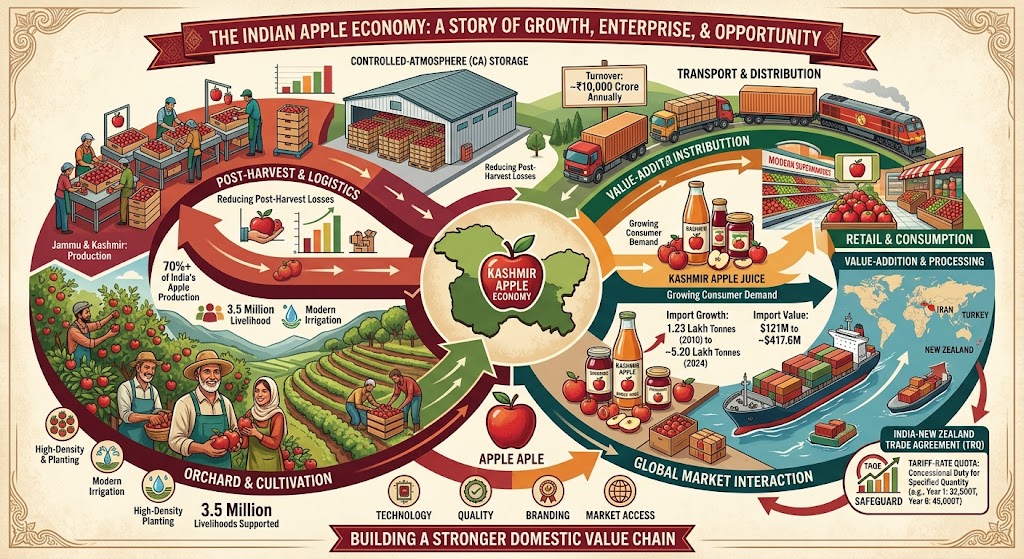
The humble apple has become much more than a seasonal fruit in India. Behind the red and green varieties seen in neighbourhood markets and modern supermarkets is a large agricultural economy involving farmers, orchard workers, traders, transporters, cold-storage operators, retailers and food-processing businesses.
At the centre of this ecosystem is Jammu and Kashmir, India’s leading apple-producing region. For thousands of families, apple orchards are a source of livelihood, while for the wider economy, horticulture has become an important driver of rural activity.
According to the latest NITI Aayog roadmap, Jammu and Kashmir produces around 2.06 million tonnes of apples and contributes more than 70 per cent of India’s apple production. Apple accounts for about half of the region’s total fruit-growing area and more than three-fourths of its fruit production.
An Economy Built Around the Orchard
The economic importance of apples extends far beyond the farm.
Once an apple is harvested, it moves through a chain of grading, packing, transportation, storage and wholesale distribution before reaching consumers. This creates employment and business opportunities across multiple sectors.
Horticulture as a whole supports around 3.5 million livelihoods in Jammu and Kashmir and contributes roughly 6–7 per cent to the Union Territory’s GDP, according to NITI Aayog. The sector generated an estimated annual turnover of around ₹10,000 crore, highlighting the scale of the horticulture economy.
This makes the apple industry an important part of the region’s rural economy rather than simply an agricultural activity.
Imports Add a New Dimension
India’s growing appetite for apples has also created a significant import market.
NITI Aayog data shows that India’s apple imports increased from about 1.23 lakh tonnes in 2010 to nearly 5.20 lakh tonnes in 2024. Import value rose from around $121 million to approximately $417.6 million over the same period. Imports have consequently grown much faster than exports.
Apples reach India from countries including Iran, Turkey, the United States, New Zealand, South Africa, Afghanistan, Chile, Poland and Italy.
For consumers, imports can provide greater availability and variety, particularly when domestic supplies are limited. For Indian growers, however, they also underline the need to improve productivity, quality, storage and marketing.
The New Zealand Factor
The issue of imports has gained additional attention following the India-New Zealand trade agreement.
Under the agreement, India has retained safeguards for apples through a tariff-rate quota (TRQ). The concessional 25 per cent duty applies only to a specified quantity, beginning at 32,500 tonnes in the first year and rising gradually to 45,000 tonnes by the sixth year. Imports outside the quota remain subject to the prevailing duty.
The government has also stressed that the arrangement is designed to balance consumer choice with protection for domestic farmers.
For Jammu and Kashmir growers, the key issue will be whether domestic apples can become competitive through better productivity, storage, branding and market access.
The Bigger Challenge Is Productivity
India’s apple story is not simply about imports versus domestic production. It is also about how efficiently Indian orchards can produce high-quality fruit.
NITI Aayog notes that Jammu and Kashmir has strong national leadership but still trails major global apple-producing regions in productivity. The roadmap therefore recommends a shift towards technology-driven, quality-focused apple cultivation rather than competing primarily through higher volumes.
High-density plantations, improved planting material, modern orchard management and better irrigation could help increase yields without requiring large increases in cultivated area.
Storage Could Change the Game
One of the biggest opportunities lies after harvesting.
Apples cannot simply be produced and sold immediately if farmers want to capture better prices throughout the year. Controlled-atmosphere storage and modern cold-chain infrastructure can allow high-quality fruit to remain available for longer periods.
Jammu and Kashmir already has significant controlled-atmosphere storage capacity, but NITI Aayog has identified the need for further expansion and better access for growers across the region. Improved pack houses, grading, sorting and pre-cooling facilities could also reduce post-harvest losses and improve the consistency of Indian apples in the market.
From Fresh Fruit to Value Addition
Another opportunity is food processing.
Apples that do not meet premium fresh-market standards do not necessarily have to become a loss for farmers. They can be converted into juice, concentrate, jams, jellies, pectin and other products.
NITI Aayog has identified significant potential for expanding such value-added processing in Jammu and Kashmir. This could create new businesses while allowing growers to earn from a larger share of their harvest.
Building a Stronger Indian Apple Brand
The future of India’s apple economy will ultimately depend on how effectively the country connects farmers with consumers.
Better infrastructure, modern cultivation techniques, stronger farmer organisations, organised retail, e-commerce and improved branding can help reduce dependence on multiple intermediaries and improve price realisation for growers.
Jammu and Kashmir already has a powerful geographical identity in the Indian apple market. The next step is to convert that reputation into stronger productivity, consistent quality and greater value addition.
A Fruit With an Economic Story
India’s apple economy is entering an important transition.
The demand is growing, imports are increasing and consumers have more choices than ever. At the same time, Indian growers are looking for better prices, improved infrastructure and greater protection from market volatility.
The answer may not lie in choosing between domestic apples and imports. It lies in building a stronger domestic value chain — one where farmers can produce better fruit, store it efficiently, access wider markets and earn more from every harvest.
From the orchards of Kashmir to India’s urban supermarkets, the apple is becoming a story of agriculture, trade, technology and rural enterprise — and its next chapter could be one of the most important for India’s horticulture economy.