
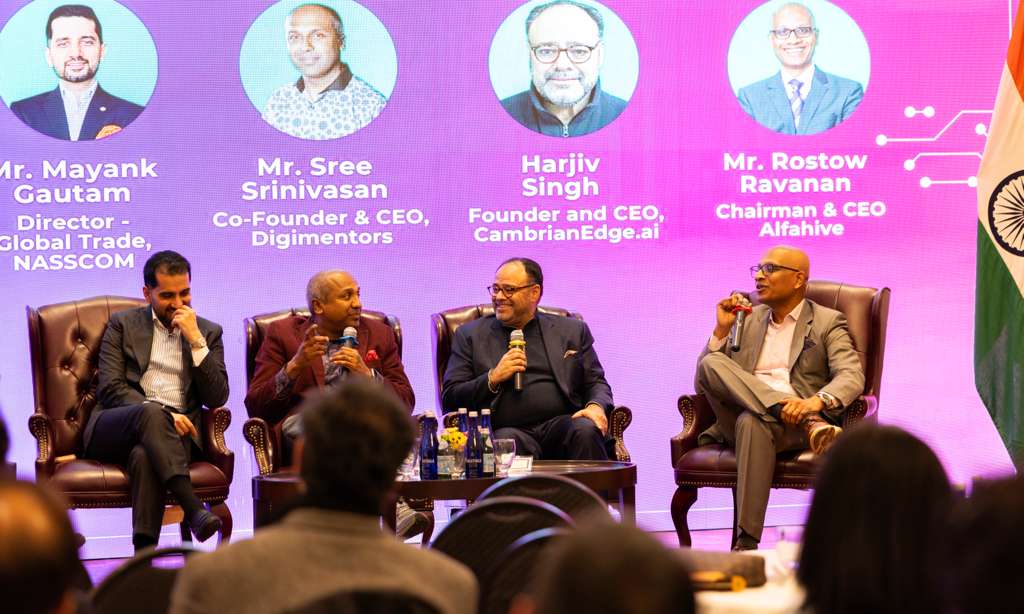
India, Apr 10: India leads the world in AI talent acquisition, with an annual hiring rate of about 33%, according to the Stanford HAI 2025 AI Index Report. With over 65% of its population under 35, India has the opportunity to reskill its workforce and integrate AI in a gradual, inclusive, and productivity-enhancing manner. This is the foundation of a strategic argument that a high-powered gathering in Midtown Manhattan made formal: India is not a spectator in the global AI race. It is, increasingly, the player the world is watching.
The Consulate General of India, New York hosted an invite-only roundtable on April 7, 2026, organized in collaboration with NASSCOM and CambrianEdge.ai. The discussion brought together five senior leaders to examine how a nation with the world’s youngest major workforce and its deepest AI optimism converts that advantage into irreversible momentum.
Forbes Contributor Anjalee Khemlani moderated the panel titled “India-U.S. Trade Opportunities in Software Services: Focusing on India’s Demographic Dividend & Emerging Opportunities in the AI Age” . Panelists include Harjiv Singh, Founder & CEO, CambrianEdge.ai; Mayank Gautam, Director of Global Trade, NASSCOM; Sree Srinivasan, Co-founder & CEO, DigiMentors; Rostow Ravanan, Chairman & CEO, Alfahive.
AI business adoption globally jumped from 55% to 78% of organizations in a single year, according to Stanford HAI’s 2025 report. The tools are everywhere. The fluency is not. The panel’s central argument: India’s young, English-speaking, technically educated population sees AI the way a previous generation saw the internet, not as a threat to be managed, but as an infrastructure to be mastered.
Mayank Gautam, Director Global Trade of NASSCOM gave the room its clearest frame: “AI is the biggest opportunity for democratization of this generation.”
“Every company, every single one, needs to ask itself one question right now: are your people AI-literate? Not eventually. Today.” – Harjiv Singh, Founder & CEO, CambrianEdge.ai
Sree Srinivasan, Co-founder & CEO of DigiMentors, brought the most concrete technology signal of the evening. The rise of “vibe coding,” building functional, deployable applications through natural language without writing every line of code, has collapsed the barrier between having an idea and shipping a product. For India’s developer community, already the second-largest contributor to global AI projects on GitHub at 19.9%, this is not an incremental shift. It is a structural expansion of what Indian builders can create, and how fast.
Rostow Ravanan, Chairman & CEO of Alfahive, grounded the ambition with the challenge that will define whether the dividend compounds or stalls. Investment in AI is accelerating sharply, but the infrastructure required to support it at scale, from power and connectivity to regulatory coherence and deep talent pipelines, must keep pace. The Deloitte-NASSCOM report projects India’s AI talent demand will more than double from 650,000 to 1.25 million professionals by 2027, with the AI market expected to grow at 25-35%, signaling an urgent need for upskilling at scale.
India’s demographic dividend, a median age of 28 and a government that has already enrolled over 16 lakh candidates in AI and digital fluency programmes through FutureSkills PRIME, is not a promise. It is a platform. The panel’s verdict: the training is underway. The urgency is to accelerate it.
Moderator Anjalee Khemlani closed with the frame that captured the evening: “AI has become an inescapable reality. If we are note finding our place in this new economy now, we will lose our footing. How we choose to do this as a society will define how we exist for future generations.”
