

In this story
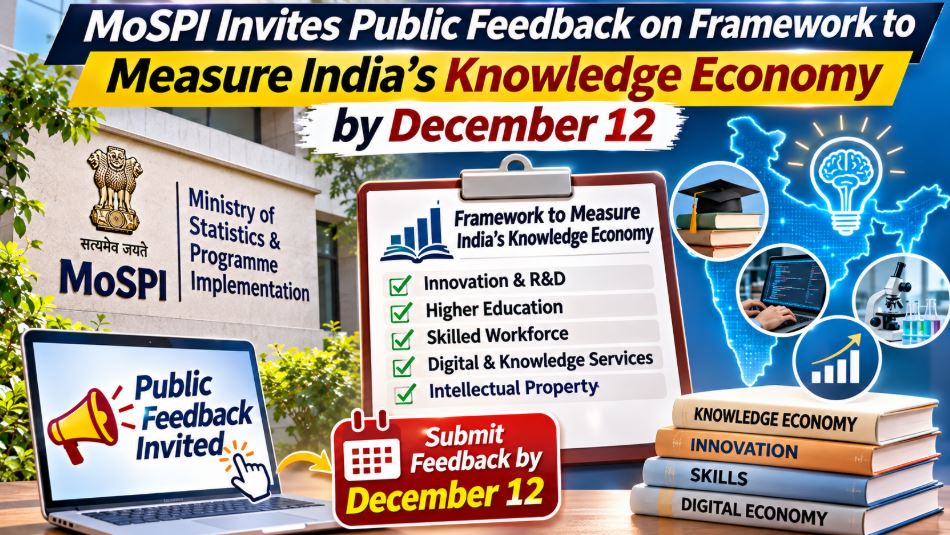
New Delhi, Nov 13: The Ministry of Statistics and Programme Implementation (MoSPI) has invited feedback and suggestions from stakeholders and the general public on a policy paper proposing a framework to measure the contribution of knowledge and knowledge-based products to the Indian economy.
Representational Image
The consultation follows the submission of the final report by the Committee on Knowledge Systems, which has prepared an Actionable Policy Paper outlining how India’s expanding knowledge ecosystem can be assessed through a structured statistical framework.
Suggestions on the report can be submitted to MoSPI at rau-2@mospi.gov.in by December 12, 2026.
The initiative seeks to develop a more comprehensive understanding of how knowledge, innovation, specialised skills and knowledge-based products contribute to economic growth, productivity, competitiveness and value creation.
Committee Recommends a Structured Knowledge Measurement Framework
The process began with a meeting chaired by Principal Scientific Adviser to the Government of India, Prof. Ajay Kumar Sood, on February 10, 2025. Subsequently, MoSPI established a Technical Advisory Group (TAG) in May 2025 under the chairmanship of Dr. R. Balasubramaniam, then Member of the Capacity Building Commission, to guide the development of a measurement framework.
The group organised a brainstorming workshop on September 30, 2025, followed by consultations with experts. These discussions contributed to the preparation of a base paper titled Framework for Measuring the Contribution of Knowledge and Knowledge Products to the Indian Economy, released in May 2026.
Building on this work, MoSPI constituted the Committee on Knowledge Systems on May 5, 2026, under the chairmanship of Ratan P. Watal, former Member Secretary of the Economic Advisory Council to the Prime Minister. The committee was tasked with preparing an actionable policy paper for measuring the economic contribution of knowledge and knowledge products.
Eight Components of the Knowledge Ecosystem Identified
The policy paper describes knowledge as an increasingly important driver of India’s development ambitions under the Viksit Bharat vision. It highlights the need to strengthen the country’s ability to generate, acquire, absorb, adapt and apply knowledge to improve productivity and create economic value.
The proposed framework identifies eight interconnected components of the knowledge ecosystem:
Knowledge
Capabilities and assets
Enabling infrastructure
Knowledge creation activities
Knowledge products
Knowledge-embedded products
Knowledge-intensive entrepreneurship
Knowledge application
It also outlines five broad principles for identifying knowledge products: knowledge as an input, knowledge content, identifiability, codification and economic value.
The committee has clarified that these principles should serve as broad guidelines rather than rigid conditions, allowing the framework to accommodate the diversity and changing nature of knowledge-based products.
Thematic Accounts Proposed Instead of a Single Measure
Recognising the complexity of measuring the entire knowledge ecosystem at once, the report recommends developing a set of thematic statistics and accounts aligned with the System of National Accounts (SNA) 2025, rather than relying on a single aggregate measure.
The proposed approach would allow policymakers to assess different areas of knowledge-related economic activity separately and identify their contributions to growth, productivity, competitiveness, inclusive development and employment.
The paper suggests prioritising thematic accounts in areas such as human capital, research and development (R&D), the creative economy, artificial intelligence systems, data and databases, high-tech products, frontier technologies and the digital economy.
Priority-setting would take into account the economic contribution of each area, its future relevance, potential to support livelihoods and the cost-effectiveness of measurement.
Federated Model for Institutional Coordination
To implement the proposed framework, the committee has recommended a federated institutional model that distributes responsibilities among organisations according to their mandates and areas of expertise.
Under this approach, system integrators would provide a common measurement framework, while domain institutions, including sectoral ministries and departments, would measure specialised components of the knowledge ecosystem.
State Governments, regulatory bodies, research organisations and academic institutions would serve as key partners in the exercise.
The report also takes note of related measurement initiatives already underway in India, including the development of a Culture Satellite Account initiated in 2025, work on measuring the Space Economy’s contribution to GDP and a 2025 study estimating the Digital Economy’s share in GDP for 2022-23.
AI and Emerging Technologies Add to Measurement Challenge
The policy paper points out that measuring knowledge-based economic activity is becoming more complex as methods of knowledge creation evolve. The growing role of advanced artificial intelligence systems, which can generate knowledge and develop solutions beyond conventional models of human knowledge creation, adds another dimension to the exercise.
The proposed framework is intended to help India identify its strengths, recognise gaps in capabilities and infrastructure, and develop evidence-based priorities for future economic planning.
MoSPI has invited comments from all interested stakeholders and members of the public as part of the consultation process. The final report is available on the Ministry’s official website under its announcements section.