July 13 : The Bengaluru Debates, a quarterly dialogue series convened by the Bangalore International Centre and Janaagraha, held its fourth session, ‘Do Bengaluru’s Young Leaders Have Hope for This City?’, on 11 July 2026 at BIC.
Since its launch in October 2025, the series has brought together elected representatives, policymakers, practitioners, and citizens to engage with Bengaluru’s most pressing governance questions – from the formation of the Greater Bengaluru Authority, to public health in the city, to transparency in public spending. The fourth session turned to a foundational question: whether the city’s young people, who have driven much of its growth and energy, believe they have a stake in shaping its future – and whether they are willing to act on it.
Bengaluru is one of India’s most youthful major cities, with nearly half its residents between the ages of 19 and 40. Yet beneath this momentum lies a growing unease. Recurring monsoon flooding in areas such as Bellandur and Marathahalli disrupts lives and commutes for weeks at a stretch. The average commuter loses 168 hours a year to traffic. These are daily reminders of a question the city has not answered: who is responsible for keeping Bengaluru’s systems and shared spaces working.
The discussion is timely. Bengaluru is set to return to the polls after more than a decade without municipal elections.
The session examined three questions: whether Bengaluru’s youth are disillusioned with polls and civic life; what it would take for young people who are aware of the city’s problems, but not yet engaged, to take the next step into civic action; and whether those who have already chosen to act believe their efforts are adding up to real change.
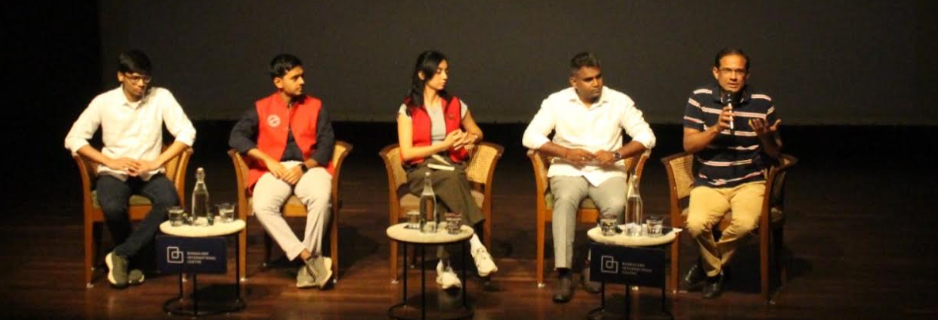
The panel featured Sarthak Sidhant, student and civic tech enthusiast; Rishvanjas Raghavan, Founder, BNP NavaYuva and Governing Council Member, Bengaluru NavaNirmana Party; Vibha Nadig, Founder and Director, Outlawed India; and Koushik Dhayal, Treasurer, Youth for Parivarthan. The discussion was moderated by Srikanth Viswanathan, Chief Executive Officer, Janaagraha.
Key insights from the discussion
Accountability is the need of the hour. Panellists observed that citizens are often unable to identify who is responsible for the services and spaces around them, and that responsibility for a single issue is frequently spread across multiple agencies. It was noted that accountability is rarely offered by institutions of their own accord; it is established when citizens ask questions consistently, and when there is an elected representative obliged to answer them. This, panellists agreed, is why local government, and the return to municipal polls, matter to the question of accountability in Bengaluru.
Transparency is necessary for accountability, but not sufficient. Panellists agreed that citizens have a right to know how public money is spent in their name, and that far too little of that information is available or usable. It was noted, however, that making information available does not by itself lead citizens to use it. Where residents are unaware of what their local government is responsible for, or what resources it holds on their behalf, disclosure produces limited scrutiny. Transparency therefore needs to be accompanied by civic education.
Responsiveness is what sustains citizen engagement. The discussion highlighted that citizens continue to engage when institutions listen and act, and withdraw when they meet silence. The value of a response, panellists reflected, lies not only in the problem it resolves but in the confidence it gives citizens that raising an issue is worthwhile.
Citizen voice is the beginning of civic change, not its outcome. Panellists reflected that Bengaluru’s problems are, for the most part, well understood, and that the knowledge of what needs to be done already exists in the city. What has been missing is the pressure and the participation that turn that knowledge into action. Citizens who ask questions, raise issues, and involve themselves in how their neighbourhoods are run, panellists agreed, are what compel a system to move.
Rishvanjas Raghavan, Founder, BNP NavaYuva, and Governing Council Member, Bengaluru NavaNirmana Party, said:
“Bengaluru does not lack ideas or solutions. The real problem is that the people who know the right thing to do are not in a position to act on it. We already know how to improve our neighbourhoods, but those with the knowledge are often not in positions where they can make decisions. Real change begins when young people move beyond raising concerns to actively participating in governance. If we can build transparent, accountable models at the ward level, they can become the foundation for transforming the city as a whole.”
Sarthak Sidhant, student and civic tech enthusiast, said:
“As citizens, we all have a responsibility to ask questions, demand accountability, and keep engaging with public institutions, even when change feels slow. Technology and open data can make governments more transparent, but meaningful change happens only when citizens continue to follow their curiosity and push for better outcomes. That collective effort is what strengthens our institutions and helps build a better country.”
Vibha Nadig, Founder and Director, Outlawed India, said:
“The cost of exacting accountability is not uniform. People experience public systems differently, and so do the opportunities they have to engage with them. Building a more participative city means ensuring that every citizen has the platform and support to engage with public institutions and believe that their voice can make a difference.”
Koushik Dhayal, Treasurer, Youth for Parivarthan, said:
“Positive change begins when citizens move beyond identifying problems to becoming part of the solution. Young people today have the energy and intent to contribute, but many are looking for the right platform to act. Whether it is improving a neighbourhood, transforming a public space, or working with local authorities, every small action helps build stronger communities. When citizens and institutions work together, meaningful and lasting change becomes possible.”
Srikanth Viswanathan, Chief Executive Officer, Janaagraha, said:
“Bengaluru’s future will depend not only on the choices made by governments, but also on whether its young citizens choose to participate in shaping the city they want to live in. As Bengaluru prepares to return to municipal elections after nearly a decade, this is an important opportunity to strengthen civic participation, build trust in public institutions, and encourage a new generation of leaders to see themselves not just as residents of the city, but as active stewards of its future. Through The Bengaluru Debates, Janaagraha and BIC hope to create the space for those conversations to grow into collective action.