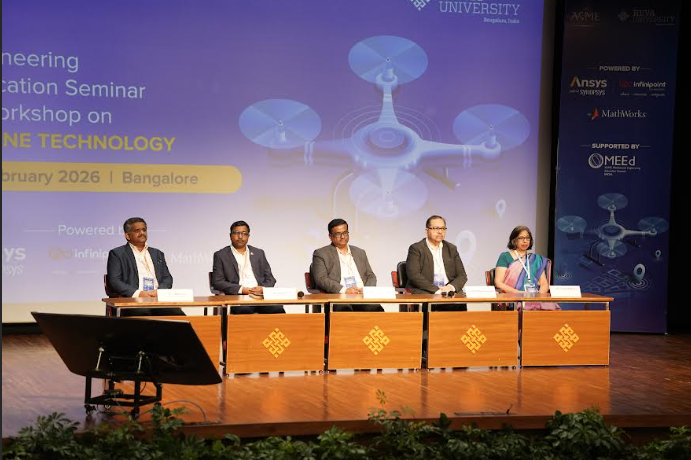
 Bengaluru, Feb 17th: The ASME Engineering Education Seminar & Workshop on Drone Technology was held at REVA University as part of the Mechanical Engineering Education Summit (MEEd), focusing on bridging the gap between classroom learning and industry-led drone applications. Hosted in Bengaluru, a growing hub for aerospace, manufacturing, and deep-tech innovation, the seminar examined how engineering education must evolve to align with real-world deployment, regulatory requirements, and business-driven use cases in the drone ecosystem.
Organised by ASME Foundation India, the seminar emphasized drone technology as an integrated, multidisciplinary system rather than a standalone technical skill. While access to basic drone assembly has become increasingly widespread, the seminar highlighted the growing demand for professionals who can combine mechanical design, electrical systems, digital intelligence, and business understanding to develop scalable, application-ready drone solutions. Through expert interactions and practical sessions, the programme highlighted the need for engineers to develop a broad, hands-on understanding of technology to build careers in drone manufacturing, testing, operations, and field deployment across sectors such as defence, agriculture, logistics, and infrastructure.
Speaking at the seminar, Mr. Madhukar Sharma, president and director of ASME India Private Limited, described the necessity of platforms such as MEEd and IMECE in keeping engineering education up to date with the realities of current engineering practice. “ASME is a not-for-profit, member-driven global engineering society committed to advancing industry-relevant learning and responsible innovation,” Sharma said. “Initiatives such as MEEd and global platforms including IMECE bring together academia, industry, and emerging technologies to shape future-ready engineers. India hosting IMECE outside the U.S. for the first time last year reflects the country’s growing contribution to the global engineering ecosystem. We look forward to the next edition of ASME IMECE India scheduled in Chennai this September.”
Setting the context of the Foundation’s work in relation to the seminar, Ms. Avni Malhotra, deputy director of ASME Foundation India, highlighted the importance of application led engineering education. “At the ASME Foundation India, we focus on ensuring that engineering education translates into real-world impact—especially in contexts where access and opportunity are limited,” said Malhotra. “Through initiatives like MEEd, we work to connect students and educators with industry realities, social challenges, and innovation pathways, so that technology is developed not in isolation, but with purpose and relevance.”
Emphasising the role of industry exposure in preparing students for a rapidly changing job market, Dr. KS Narayana Swamy, pro vice chancellor, REVA University, noted that seminars and workshops such as the ASME MEEd programme help students remain relevant amid technological disruption. “Engineering careers today demand far more than academic credentials,” Swamy said. “Students must build problem-solving ability, communication skills, and adaptability, while engaging closely with industry to understand evolving expectations and future career pathways.”
The seminar brought together professionals working closely with India’s growing drone and aerospace landscape. Industry leaders such as Mr. Abhishek Burman, co-founder and CEO, General Aeronautics Pvt Ltd; Mr. Zain Saeed, co-founder and COO, Enord; Dr. Ananda CM, program director for Civil Aircrafts and head of the Aerospace Electronics Division, NAL; and Dr. Subrata Nayak, R&D technical lead, ideaForge Technology Inc., shared insights drawn from real industry experience. During the sessions, speakers broke down how drones move from concept to real-world use, covering design decisions, manufacturing processes, certification requirements, deployment challenges, and the regulatory landscape. The discussions also highlighted the blend of technical expertise and cross-functional skills needed to build sustainable careers in UAV-related fields.
Academic insights were shared by Dr. M. Sivapragasam, professor, M. S. Ramaiah University of Applied Sciences, and Dr. Manjunath S V, associate professor and head of the Department of Aeronautical Engineering at Mangalore Institute of Technology and Engineering. They spoke about the need to better align academic curricula with industry expectations and to strengthen hands-on, experiential learning within engineering programmes.
The seminar also featured a hands-on workshop on Drone Technology in Mechanical Engineering Using ANSYS Simulation, conducted by Mr. Gokul Raj M, technical account manager at Infinipoint Technologies Pvt Ltd, and powered by ANSYS, part of Synopsys. The workshop gave participants a practical look at how simulation tools and AI-enabled UAV workflows are used in real engineering environments, from design validation to testing and operational planning. Two other workshops were also organised: Enabling Next-Generation Autonomous System Workflows: From Design to Deployment by MathWorks, led by Ms. Richa Singh, application engineer, MathWorks; and Physics-Informed Machine Learning for Drones/UAV by ASME Cyber Physical Systems India, conducted by Mr. Anand Nagarajan of Airbus and Mr. Unnat Mankad of Baker Hughes.
Beyond the technical sessions, the seminar created space for open conversations between faculty members, students, and industry professionals on curriculum relevance, evolving skill expectations, and on-the-ground industry realities. Participants also used the platform to network with practitioners and technology experts, underlining the value of industry-connected learning pathways in drone technology and related engineering fields.
Over the past two years, the MEEd Summits in India have played a key role in bridging the gap between industry and academia, with support from the MEEd India Steering Committee,comprising industry leaders, vice chancellors, and leading researchers. The seminar was supported by technology and industry partners, including ANSYS (part of Synopsys), Infinipoint Technologies, and MathWorks, strengthening the programme’s focus on applied learning, AI driven engineering workflows, and career-oriented skill development.