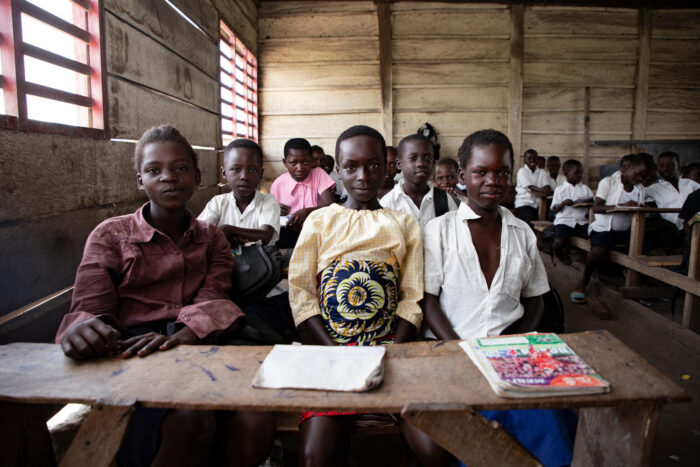
Kinshasa, Feb 09 – As the provinces of eastern Democratic Republic of the Congo (DRC) continue to face an unprecedented humanitarian crisis, Education Cannot Wait (ECW) is scaling up its support with a new US$10 million investment for a two‑year education resilience programme (2025–2027).
Implemented under UNICEF’s leadership, and in partnership with Save the Children, World Vision and the local NGO Femmes Dynamiques pour le Progrès Social, the programme aims to restore a safe learning environment for more than 62,600 children in the Ituri Province. The intervention places particular emphasis on girls and crisis‑affected internally displaced populations.
The renewed wave of violence and insecurity that has struck eastern DRC since 2025 has forced tens of thousands of families to flee. Widespread destruction in the affected areas has severely disrupted access to basic social services and livelihoods. Children are bearing the brunt of the crisis: insecurity, trauma, displacement, hunger and heightened protection risks – including gender‑based violence and sexual violence – deeply affect their daily lives. Adolescent girls are especially at risk.
“In Ituri and across eastern DRC, millions of children see their futures threatened by violence and displacement. Education is their lifeline: it protects, restores hope and serves as a vital driver of community resilience. With this new programme, we are working hand‑in‑hand with our partners to ensure that no child is left behind,” said Graham Lang, Director a.i. of ECW.
The “Multi-Year Resilience Programme (MYRP) II” was launched during a high‑level mission to DRC led by Mr. Lang from 1–9 February 2026. The ECW delegation met with children and families who will benefit from the programme, local implementing partners, and national and provincial authorities.
“School must be where children feel better, even after they have experienced war. Thanks to the MYRP funded by ECW, we will repair what has been destroyed. If we want peace in Ituri, it starts with ensuring our children learn in good conditions so they no longer drop out of school,” said Yvon Muke Abwasel, Provincial Director of National Education and New Citizenship, Ituri 1.
“The MYRP funding supports the implementation of the Education and Training in Emergencies Strategy recently adopted by the Government. I welcome the holistic approach taken to address the educational needs of children affected by the crisis in the east of the country. Together with the other members of the consortium established for the implementation of the MYRP, UNICEF is committed to ensuring efficient delivery of the programme,” said Mariame Sylla, UNICEF Deputy Representative in DRC.
The success of the programme hinges on the strong engagement of national authorities and local communities. Such collaboration is essential to ensure continuity of learning and uphold every child’s right to education, despite ongoing humanitarian crises.
This new allocation builds on the US$5 million emergency grant ECW provided in 2025 to War Child Alliance to support interventions in North and South Kivu, bringing ECW’s total investments in DRC to more than US$47 million since 2018.
Thanks to sustained efforts by the Government and its partners, access to primary education in DRC has seen significant progress, with a 57.5% increase in enrolment between 2011 and 2020. However, the country continues to face one of the world’s most severe humanitarian crises. Renewed violence in the eastern provinces has intensified needs and put these gains at risk. Nationwide, 8 million children remain out of school.
“This new investment marks an important step forward for children in eastern DRC, but it is far from sufficient to meet the scale of needs. In DRC and around the world, more than 230 million children are affected by crises and urgently require support to learn and thrive. I call on public and private donors to step up and contribute to the US$600 million required for ECW’s 2027–2030 Strategic Plan. Together, we can provide millions of children with the protection, dignity and opportunities that education brings, and help build a more stable and sustainable future for all,” Mr. Lang added.