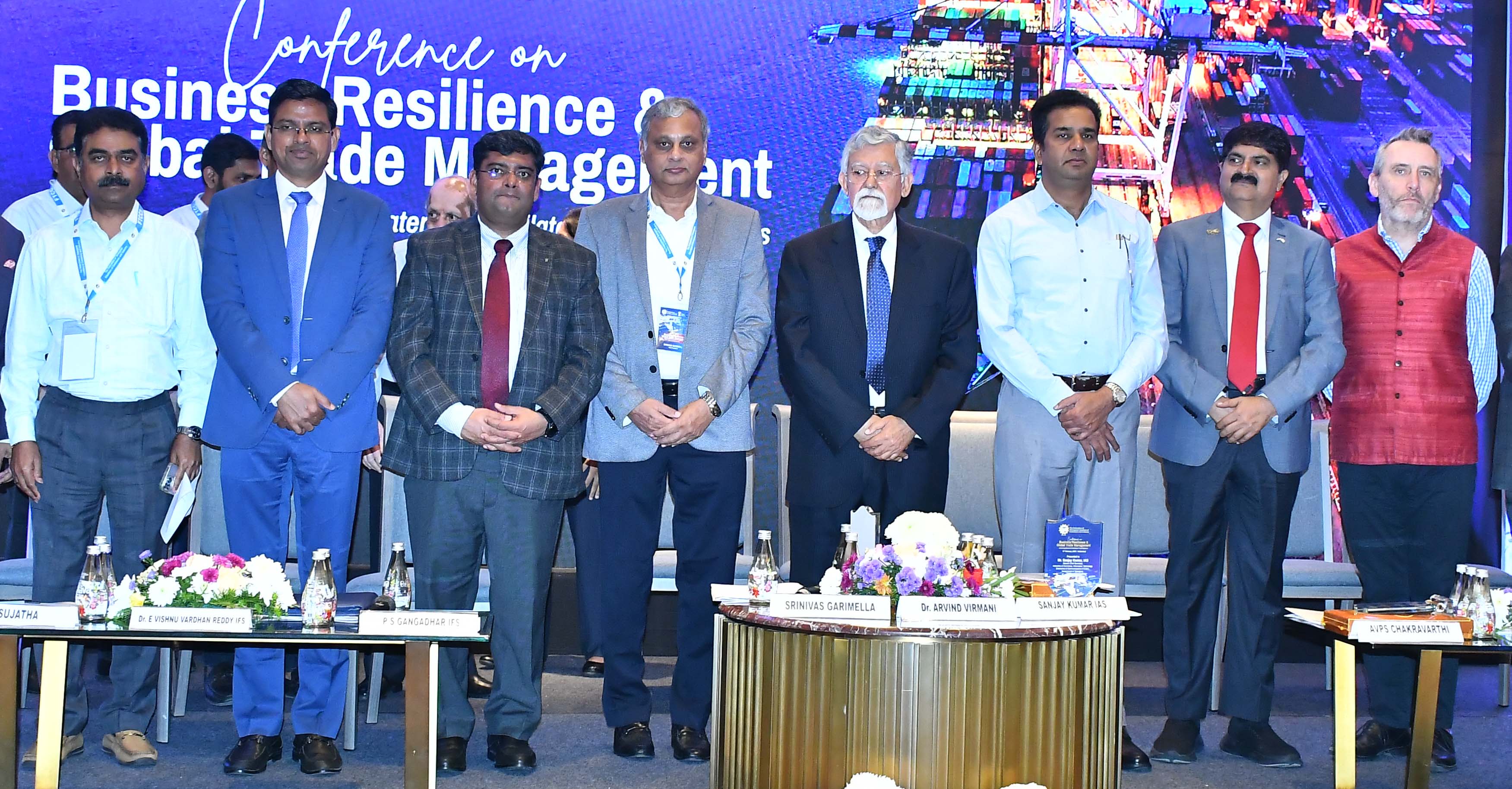
Hyderabad, Feb 6: A full-day conference on Business Resilience & Global Trade Management, themed “Advancing Bilateral and Multilateral Trade Relations”, was held on Friday at Hotel Leela, Hyderabad.
The conference was organised by the Federation of Telangana Chambers of Commerce and Industry (FTCCI) as a part of States facilitation and Knowledge Support activities of the Ministry of External Affairs, Government of India, and with the support of State Bank of India (SBI).
Dr Arvind Virmani, Member, NITI Aayog, was the Chief Guest and inaugurated the conference in the presence of several dignitaries from government, diplomacy, industry, and academia.
Addressing a gathering of over 150 participants, Dr Virmani stated that India’s economic growth remains encouraging and is accelerating relative to the global economy. Drawing comparisons with China, the United States, and other major economies, he highlighted rising employment trends and strong macroeconomic fundamentals.
He spoke on two major global trends—global demographics and world manufacturing—noting that India’s growth trajectory continues to strengthen in comparison to both the global average and China. Addressing concerns around so-called “jobless growth,” Dr Virmani stated that employment generation in India is occurring at a pace faster than its population growth.
Emphasising that skilling is the key, he said India’s share in the global labour force will continue to rise, giving the country a strong comparative advantage in human capital. Referring to China, he observed that no single country can control global manufacturing and pointed to the growing concentration of world-manufactured exports, adding that India is well-positioned to meet rising global demand.
Dr Virmani outlined key reforms required to remain globally competitive, including labour codes, tax compliance reforms, a quality-first approach, and Free Trade Agreements (FTAs). Concluding his keynote address, he stated that India is well placed to become an Upper-Middle-Income Country (UMIC) and eventually a High-Income Country (HIC)—classifications defined by the World Bank based on Gross National Income (GNI) per capita.
In his closing remarks, Dr Virmani predicted that India would overtake Germany within the next two to three years and surpass the European Union by 2050.
Sanjay Kumar, Special Chief Secretary, Industries & Commerce, IT E&C Department, Government of Telangana, spoke on the vast opportunities for a young state like Telangana and outlined initiatives being undertaken to strengthen its economic ecosystem.
He said Telangana ranks 6th in export preparedness, with focused investments in infrastructure—such as the Regional Ring Road (RRR) and radial roads—driving export growth. Telangana’s exports grew by 36 percent to USD 19 billion in 2024–25, while IT exports are expected to touch ₹3 lakh crore in the current year. He noted that Telangana is increasingly competing not just with Indian states, but with global cities.
Highlighting the launch of the country’s first state-led AI Hub, Mr. Kumar said a new GCC Policy is on the anvil, while the IT Policy, introduced over a decade ago, is undergoing a comprehensive revision. He also spoke about the R&D-focused Life Sciences Policy, under which R&D has been accorded industry status, adding that pharma and aerospace exports are growing steadily alongside IT exports.
Referring to the Telangana Rising initiative, he said it has significantly boosted investor confidence. The state has mobilised USD 70 billion in investments, with a strike rate exceeding 60 percent, far above the industry average of 25–30 percent. He added that two to three logistics parks and dry ports are currently under development.
P. S. Gangadhar, IFS, Joint Secretary (Economic Diplomacy), Ministry of External Affairs, said global trade has become increasingly challenging and complex in recent times. Despite this, India has concluded nine trade deals in the past six years, including six in the last 44 months, reflecting India’s proactive and swift response to global changes.
He said FTAs are the way forward and are now an integral part of India’s economic resilience strategy, adding that India is increasingly defining global trade and investment engagement on its own terms. “We must build resilient businesses for a resilient India,” he said.
E. Vishnu Vardhan Reddy, IFS, Head, Branch Secretariat, Ministry of External Affairs, stated that dependence on a single nation is no longer viable. He said India’s FTAs send a strong message of inclusive and collaborative growth, adding, “We grow together.”
Gareth Wynn Owen, British Deputy High Commissioner, Hyderabad, highlighted the importance of strengthening UK–India trade and investment ties and called for deeper collaboration and resilient partnerships.
Srinivas Garimella, Vice President, FTCCI, said Telangana stands to gain significantly from India’s FTAs. He noted that the state’s exports stood at USD 18 billion last year and are expected to grow by around 25 percent annually.
Chakravarthi AVPS, Chairman, International Trade & Business Relations Committee, FTCCI, said, “In early 2026, India has moved beyond the turning point and into a full sprint in global trade. With landmark agreements and record exports, we are not just participating in global commerce—we are helping shape its rules.”
Radhakrishnan, Chief General Manager, SBI, said the bank has 1,200 branches in Telangana, adding that “Telangana is not just the pharma capital of India, but a true brain capital.”
The conference also featured three technical panel sessions covering strategic FTAs, export diversification, and government enablers for export excellence, with discussions on supply chains, digital trade platforms, credit facilities, and risk mitigation—emphasising the need for resilient, diversified, and future-ready export ecosystems.
—